
Northern Virginia HVAC Guide: Costs, Repairs, Rebates & Local Advice
🏘️ 30+ Neighborhoods
Every major community across Alexandria, Arlington and Fairfax County
📊 Data-Backed
NOAA 2025 climate data and real 2026 Northern Virginia cost ranges
🔧 Diagnostic-First
Honest guidance from a contractor who measures before recommending

The Northern Virginia HVAC Guide was created to help local homeowners understand how regional humidity, housing age, duct design, equipment sizing, and installation quality affect comfort and system life.
How Northern Virginia Humidity Damages HVAC Systems
Why Northern Virginia HVAC fails faster – and what that quietly costs you.
A central focus of this Northern Virginia HVAC Guide is the region’s unusually heavy summer moisture load.
Northern Virginia doesn’t have a heat problem. It has a humidity problem.
Northern Virginia summers routinely combine high temperatures with elevated dew points, creating a substantial moisture load for residential cooling systems. That moisture doesn’t just make homes uncomfortable — it accelerates blower motor wear, corrodes coils, stresses compressors, and exposes every weakness in a duct system.
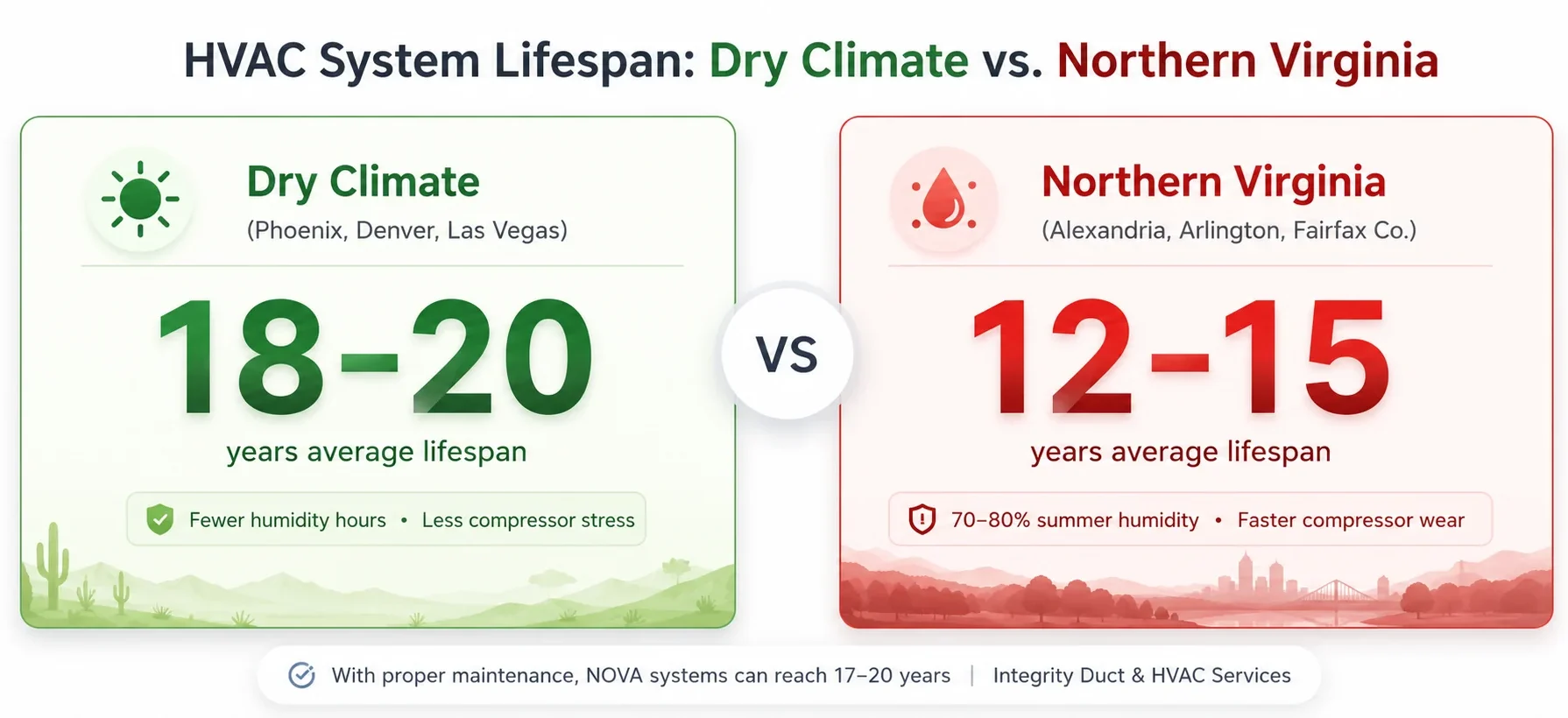
In dry climates, HVAC systems often last 18–20 years. In Alexandria, Arlington, and Fairfax County, 12–15 years is realistic without proper sizing and maintenance. That difference quietly costs homeowners thousands in premature replacement — often without them ever understanding why.
This guide breaks down every major NOVA housing profile and what actually works in each one — written by Integrity Duct & HVAC Services, a BBB A+ rated, Virginia Class A licensed contractor based in Alexandria.
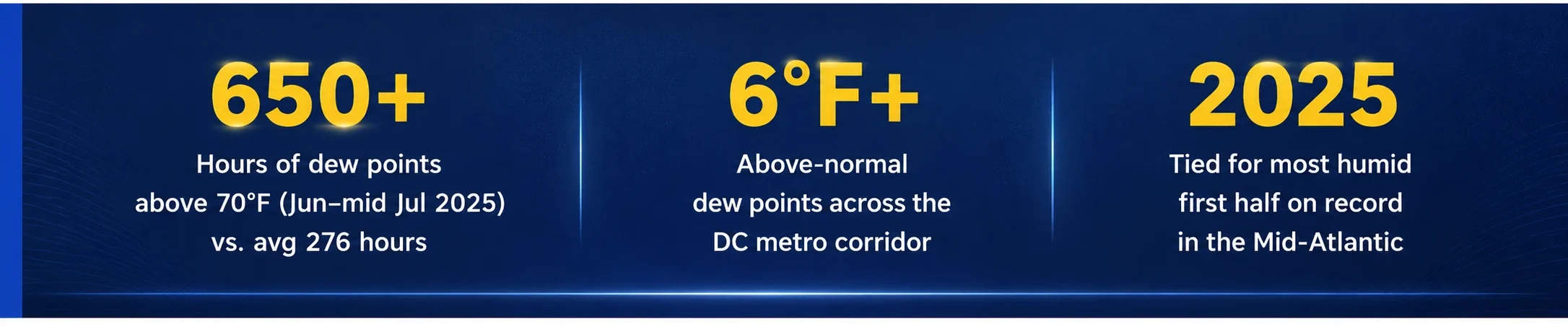
The DC region experienced an unusually prolonged stretch of elevated dew points during summer 2025. Local reporting documented more than 650 hours with dew points above 70°F from June through mid-July, substantially above the historical average.
NOAA Climate Verification
The 2025 DC metro saw 650+ hours of dew points above 70°F from June 1–mid-July, versus a historical average of 276 hours. Dew points ran 6°F+ above normal region-wide — tied for most humid first half on record in the Mid-Atlantic (NOAA/NCEI 2025 Annual Climate Report). Climate projections indicate 2026 may see similar or greater humidity loads due to sustained warming patterns.
How Northern Virginia’s Humidity Affects HVAC System Lifespan
The Impact of Humidity on HVAC Lifespan
Northern Virginia HVAC systems often work harder than comparable equipment in dry climates. High summer humidity increases runtime, moisture removal demands, condensate production, and compressor wear—especially when equipment is oversized, poorly maintained, or improperly installed.
| Regional Stressor | Impact on Your Equipment |
|---|---|
| High Summer Dew Points and Humidity | Forces cooling and dehumidification simultaneously, resulting in longer runtimes and greater compressor wear. |
| Rapid Spring Temperature Swings (25–35°F) |
Frequent cycling places added stress on relays, capacitors, and control boards. |
| Thunderstorm Voltage Spikes | Can damage control boards and compressors. HVAC surge protection can help prevent expensive failures. |
| Aging Duct Systems (1950s–1980s) |
Many were designed for gravity heating rather than forced-air cooling, contributing to chronic high static pressure. |
| Builder Oversizing (1990s–2000s) |
Causes short cycling, poor dehumidification, and accelerated equipment wear—one of Northern Virginia’s most underdiagnosed HVAC problems. |
| Three-Level Townhome Stack Effect | Creates hot upper floors that a single-zone thermostat may not be able to fully correct. |
| Clay-Heavy Soil and Basements | Ground moisture can migrate into basements even when the air-conditioning system is operating normally. |
| A2L Refrigerant Transition (2025-2026) |
The phase-in of new low-GWP refrigerants may increase some equipment and installation costs because of new refrigerants, redesigned components, training requirements, and changing equipment availability. |
Seasonal HVAC Maintenance for Northern Virginia Homes
What to do to maintain your HVAC system year-round.
This Northern Virginia HVAC Guide organizes preventive maintenance by season because local systems face very different demands throughout the year.
Northern Virginia’s rapid seasonal changes place different demands on HVAC equipment throughout the year. Following a seasonal maintenance schedule helps reduce breakdowns, improve humidity control, maintain energy efficiency, and extend system life. Visit our Seasonal HVAC Maintenance page for more information, and to view our HVAC maintenance packages.
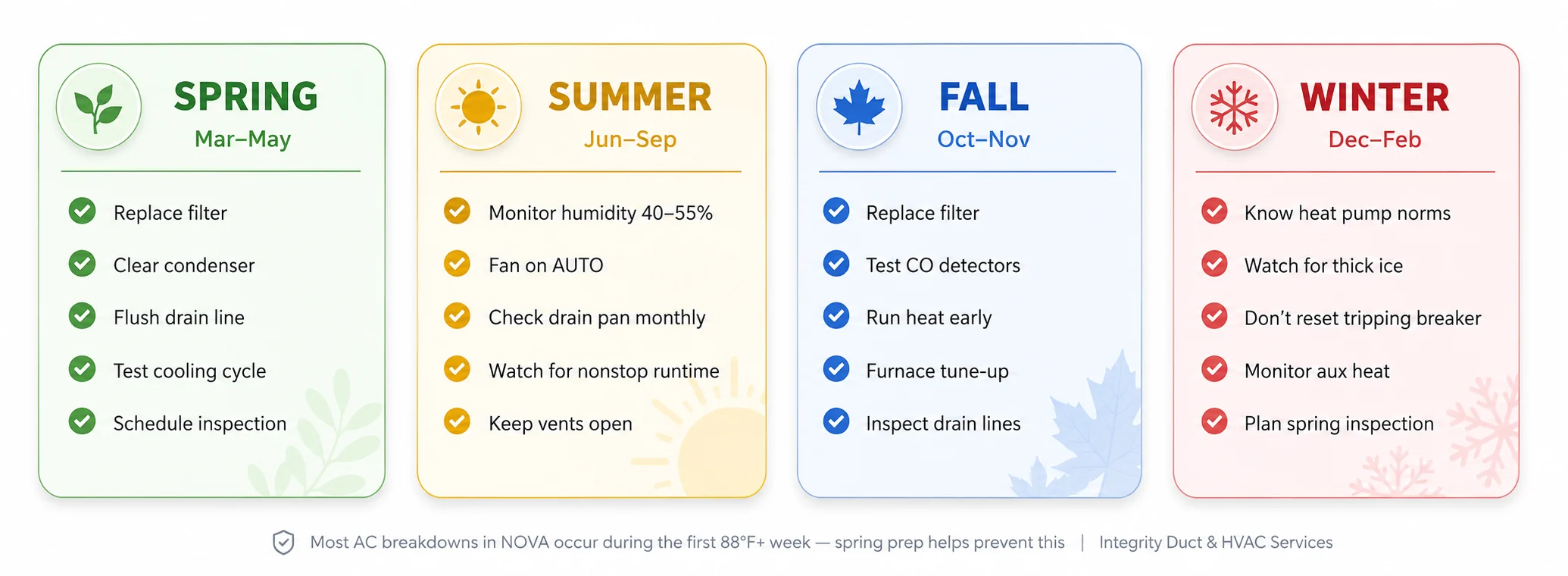
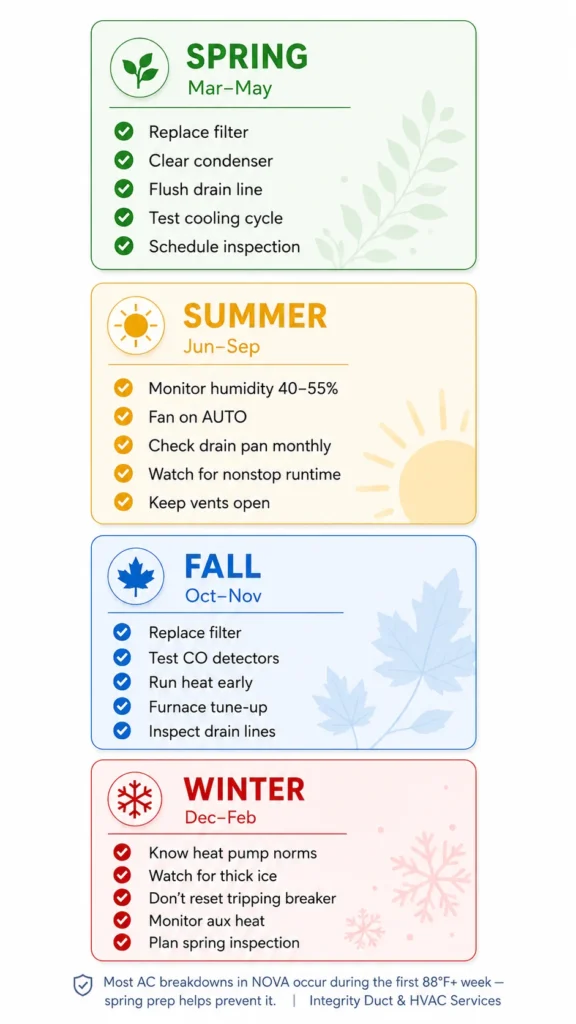
A season-by-season HVAC maintenance timeline for Northern Virginia homeowners, including filter changes, humidity monitoring, furnace checks, drain-line inspections, and heat-pump precautions.
🌱 Spring — Before the First 85° Week
Most Alexandria and Fairfax County AC breakdowns happen during the first serious heatwave — often late May or early June. Systems that limped through winter fail under sudden humidity load. Spring prep prevents this.
| Spring Action | What To Do & Why |
|---|---|
| Replace Air Filter | Use the correct size and point the airflow arrow toward the air handler. In high-humidity Northern Virginia homes, replace filters every 30–45 days during summer, not every 90 days. |
| Clear Outdoor Condenser | Maintain 18–24 inches of clearance around the outdoor unit. Rinse the coils gently from top to bottom with a garden hose using low pressure only. |
| Flush Condensate Drain | Pour 1 cup of white vinegar into the PVC access point. Clogged condensate drains are one of the most preventable spring emergency calls in Del Ray and Rosemont. |
| Listen for Refrigerant Hiss | Faint hissing near the air handler or outdoor unit may signal a refrigerant leak. Schedule an inspection before peak summer temperatures arrive. |
| Inspect Evaporator Coil for Ice | Ice on the coil usually indicates restricted airflow or low refrigerant. Turn the system off and do not operate it while frozen. |
| Test Cooling Cycle | Lower the thermostat by 3–5°F. Cool air should begin flowing within two to three minutes. Weak airflow may indicate a filter, blower, or duct problem. |
| Schedule Professional Inspection | Request a static-pressure test, capacitor check, refrigerant-level inspection, and overall system evaluation. Spending $150–$250 now may prevent a $600–$2,500 repair during July heat. |
✅ Quick Win
Spring Timing: Schedule your inspection in March or early April — before the first wave of emergency calls fills service calendars in May.
☀️ Summer — Humidity Defense Mode
If 72° feels sticky and humid, the problem is almost never the thermostat setting. Indoor humidity above 60% is uncomfortable at any temperature — and creates mold risk within 24–48 hours on surfaces.
| Action | Why It Matters in NOVA |
|---|---|
| Set Fan to AUTO, Not ON | Continuous fan mode recirculates moist air between cooling cycles, reintroducing humidity the system just removed. |
| Monitor Indoor Humidity | Target 40–55%. A $25–$40 digital hygrometer is one of the most useful HVAC investments a Northern Virginia homeowner can make. |
| Do Not Close Multiple Vents | Closing three or more vents can significantly raise static pressure and strain the blower. The system was sized to operate with an open duct network. |
| Watch for Nonstop Runtime | Continuous operation without reaching the thermostat setting may indicate low refrigerant, restricted airflow, or an undersized system. |
| Inspect Drain Pan Monthly | A full condensate pan usually signals a clogged drain. Mold can begin growing in standing water within 24–48 hours during a Northern Virginia summer. |
| Keep Registers Unobstructed | Furniture blocking supply registers creates airflow and pressure problems that compound existing duct restrictions. |
⚠️ Watch Out
Basements in Fort Hunt, West Springfield, Rose Hill, and Springfield are especially vulnerable during peak humidity months. If your basement smells musty while the AC runs normally upstairs, the system is not failing — the moisture load exceeds what a standard AC can dehumidify. A dedicated dehumidifier is usually the correct fix, not a new system.
🍂 Fall — Heating & Heat Pump Prep
Fall is the best time to test your heating system before Northern Virginia’s first cold snap. A quick inspection now can catch airflow problems, worn components, and heat-pump issues before emergency service season begins.
| Action | Why It Matters |
|---|---|
| Replace Filter | Start the heating season with a clean filter. This improves airflow and reduces furnace strain during Northern Virginia cold snaps. |
| Test CO Detectors | Carbon monoxide from a cracked heat exchanger is invisible and potentially deadly. Test every detector before using the heating system each year. |
| Run Heat Early in October | A 10-minute test run burns off settled dust and may reveal problems before winter emergency season. Note any persistent burning smell, unusual noise, or failure to produce warm air. |
| Inspect Condensate Drain Lines | Even mild Northern Virginia winters can freeze high-efficiency furnace condensate lines. Check the insulation, drainage slope, and exterior termination. |
| Schedule Furnace Tune-Up | A professional tune-up should include burner cleaning, heat-exchanger inspection, and a flue and venting check—especially for systems more than 8 years old. |
| Check Heat Pump Refrigerant | Heat pumps that struggled during cooling season may reveal low-refrigerant or airflow problems in heating mode. Test the system before cold weather arrives. |
❄️ Winter — Heating Guide
Heat pumps are increasingly common in Northern Virginia due to federal incentives and Virginia electrification programs. Understanding normal vs. abnormal behavior prevents unnecessary service calls.
| Situation | Normal or Not? |
|---|---|
| Steam Rising From Outdoor Unit | NORMAL — This is the defrost cycle. The system briefly runs in reverse to melt frost from the outdoor coil and typically lasts 5–15 minutes. |
| Outdoor Fan Shuts Off Briefly | NORMAL — This is part of defrost mode. The outdoor fan stops temporarily so the coil can warm and melt accumulated frost. |
| Thin Frost on Outdoor Coil | NORMAL — A light coating of frost is expected during cold weather. The system’s automatic defrost cycle should remove it. |
| Thick Ice Buildup on Outdoor Unit | NOT NORMAL — Call for service. Thick ice may indicate blocked airflow, low refrigerant, or a failed defrost component. Do not chip or break the ice manually. |
| Breaker Repeatedly Trips | NOT NORMAL — Stop resetting the breaker. Repeated resets can cause additional compressor or electrical damage. Call for service immediately. |
| Auxiliary Heat Runs Constantly Above 40°F | MONITOR — Auxiliary heat below approximately 35°F may be normal. Constant auxiliary heat at 40°F or higher can signal a thermostat, refrigerant, airflow, or heat-pump problem. |
When an HVAC Problem Becomes Urgent in Northern Virginia
Preventive maintenance can reduce breakdowns, but heating and cooling systems can still fail during Northern Virginia's cold snaps, heat waves, and high-humidity summer weather. If your system has stopped heating or cooling, is repeatedly shutting down, or is showing signs of a potentially serious failure, use the guides below to understand what you can safely check, when to stop operating the equipment, and how Integrity handles priority HVAC service requests in Alexandria and nearby Northern Virginia communities.
Emergency HVAC Repair in Alexandria & Northern Virginia
Not sure whether the problem involves heating, cooling, airflow, electrical components, or another HVAC failure? Start with our emergency HVAC guide for homeowner checks, safety information, priority service details, pricing expectations, and what happens when you call.
Emergency HVAC Repair Guide →Emergency Heating Repair in Alexandria & Northern Virginia
No heat, furnace failure, heat pump trouble, thick ice on the outdoor unit, repeated breaker trips, short cycling, or unusual heating-system odors? Learn what you can safely check, when to shut the system down, and how Integrity prioritizes urgent heating repair requests during Northern Virginia cold weather.
Emergency Heating Repair Guide →Emergency AC Repair in Alexandria & Northern Virginia
AC stopped cooling, blowing warm air, freezing up, leaking water, repeatedly tripping a breaker, or running nonstop during extreme heat? Learn what you can safely check first and how Integrity prioritizes urgent air conditioning repair requests during Northern Virginia's hot, humid summers.
Emergency AC Repair Guide →HVAC Problems in Alexandria, Arlington and Fairfax Neighborhoods
30+ NOVA communities — construction era, housing type, and what breaks first
The neighborhood profiles in this Northern Virginia HVAC Guide are organized around the most important diagnostic variable: the home’s construction era. Each decade of local housing has its own recurring airflow, humidity, ductwork, and equipment problems.
The most critical variable in diagnosing a NOVA HVAC problem is the home’s construction era. Each decade of Northern Virginia housing has its own dominant failure profile. The profiles below translate that knowledge neighborhood by neighborhood — so you know what to expect before calling anyone.
Why Third Floors Stay Hot in Northern Virginia Townhomes
Three-level townhomes often experience major temperature differences between floors. Cool air settles downstairs while heat rises, leaving the third floor uncomfortable even when the first floor reaches the thermostat setting. A properly designed zoning system can provide separate control for each level.
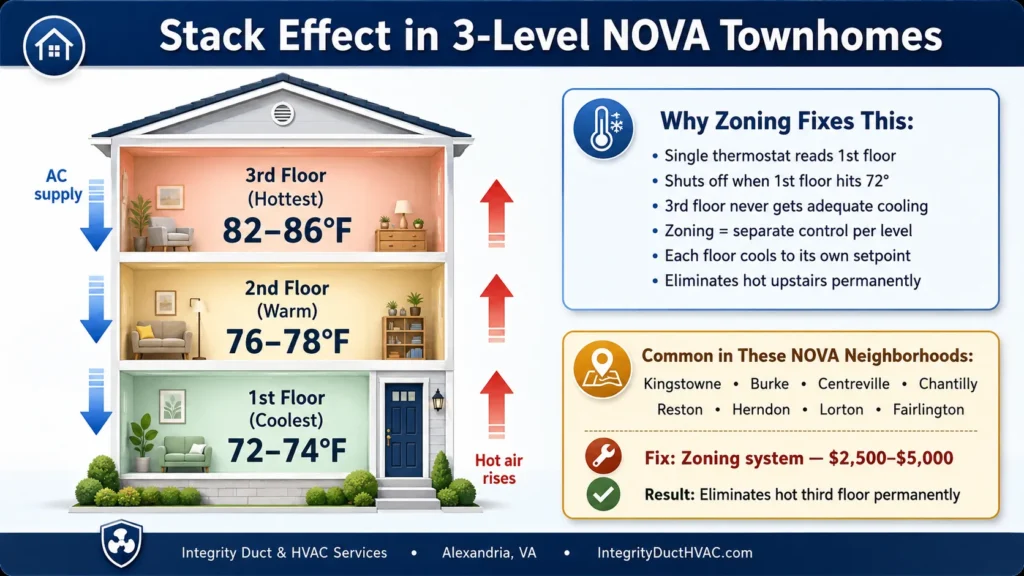
Stack effect can leave the third floor of a Northern Virginia townhome 8–14°F warmer than the first floor. HVAC zoning provides separate temperature control for each level.
Alexandria HVAC Problems by Neighborhood
Housing spans 200+ years. Every neighborhood has a distinct HVAC profile.
For full service coverage, local credentials, and scheduling information, visit our HVAC Contractor in Alexandria VA service-area page.
Core Problem Pattern: Retrofitted ductwork in 18th–19th century masonry with river humidity and severe space constraints
Historic waterfront row homes with some of the most complex HVAC retrofit work in Northern Virginia. Tight chases, riverside humidity, and historic preservation requirements that may limit duct routing options. High static pressure is nearly universal. Homeowners facing these considerations can learn more about our Old Town Alexandria HVAC Services here.
| Housing Era | 18th–19th century |
|---|---|
| Housing Type | Historic row homes and masonry construction |
| HVAC Problem Profile | Undersized retrofitted ducts, high static pressure, river humidity, and limited chase access |
| Best Fix Path | Airflow redesign, duct sealing, variable-speed systems, and dehumidifier integration |
Core Problem Pattern: Retrofit duct systems in pre-HVAC bungalows — crawlspace leakage and undersized returns
One of Alexandria’s most engaged and online communities. Craftsman bungalows and early colonial homes built before modern HVAC — every system is a retrofit into spaces not designed for ductwork. Del Ray homeowners research contractors carefully and share recommendations actively. Craftsman homes and bungalows often have undersized returns and crawlspace leakage. See our dedicated HVAC Services in DelRay page for local airflow and repair guidance.
| Housing Era | 1920s–1950s |
|---|---|
| Housing Type | Bungalows and Craftsman homes |
| HVAC Problem Profile | Undersized returns, crawlspace air leakage, aging trunk lines, and high static pressure |
| Best Fix Path | Return enlargement, duct sealing, airflow balancing, and crawlspace encapsulation |
💡 Integrity Tip
Del Ray: Condensate drain clogs are the #1 preventable spring service call here. Old PVC drain lines narrow with mineral buildup. One cup of vinegar in March prevents an emergency call in July.
Core Problem Pattern: Gravity-era return ducts not adapted for modern cooling loads — basement moisture from clay soils
Colonials and cape cods on clay-heavy soil with persistent basement moisture. Many homes originally had gravity-fed heating retrofitted for AC, leaving return duct layouts that weren’t designed for modern cooling demands. Local homeowners can learn more by visiting our Rosemont HVAC Services page.
| Housing Era | 1930s–1950s |
|---|---|
| Housing Type | Colonials and Cape Cods |
| HVAC Problem Profile | Basement moisture, gravity-era return ducts, and humidity infiltration through the foundation |
| Best Fix Path | Return redesign, dehumidifier integration, vapor barrier installation, and duct sealing |
Core Problem Pattern: Unsealed duct penetrations — humid outdoor air infiltrating directly into the duct system
Older duplexes and row homes at Alexandria’s northern edge. Duct penetrations were frequently never sealed — gaps between conditioned and unconditioned spaces allow humid outdoor air to infiltrate the duct system, dramatically increasing moisture load on equipment. Unsealed duct penetrations are especially common in older Arlandria duplexes and row homes. Learn more about HVAC Services in Arlandria.
| Housing Era | 1940s–1960s |
|---|---|
| Housing Type | Duplexes and row homes |
| HVAC Problem Profile | Leaky, unsealed duct penetrations, humid air infiltration, and aging HVAC equipment |
| Best Fix Path | Duct sealing with mastic or Aeroseal, static pressure testing, and airflow balancing |
Seminary Hill / Beverly Hills Alexandria (22304)
Core Problem Pattern: Load mismatch from past non-Manual-J replacements — undersized returns and static pressure
An underserved Alexandria pocket that many contractors overlook. Mid-century single-family homes with variable square footage where load mismatches from past rule-of-thumb replacements are common. Homeowners here appreciate contractors who know their neighborhood exists.
| Housing Era | 1950s–1970s |
|---|---|
| Housing Type | Mid-century single-family homes and colonials |
| HVAC Problem Profile | Undersized returns, elevated static pressure, and load mismatch from prior system replacements |
| Best Fix Path | Static pressure testing, Manual J load calculation, and return-air enlargement |
Rose Hill (22310)
Core Problem Pattern: Heating-era duct design in single-story ramblers — high static pressure, uneven cooling
Single-story ramblers built primarily for heating performance. Their low-profile duct systems were never engineered for the volume and distribution demands of modern central cooling. High static pressure and uneven bedroom cooling are nearly universal.
| Housing Era | 1950s–1970s |
|---|---|
| Housing Type | Ramblers and ranch homes |
| HVAC Problem Profile | Heating-era ductwork adapted for cooling, high static pressure, and uneven room-to-room air distribution |
| Best Fix Path | Static pressure testing, return-air enlargement, and airflow redistribution |
Core Problem Pattern: River humidity exceeds standard AC dehumidification capacity — basement mold despite functional equipment
River proximity creates humidity loads that exceed what a standard AC system can manage. Basement mold complaints frequently arrive alongside a functioning AC — the issue isn’t equipment failure, it’s moisture load. Many Fort Hunt homeowners have replaced systems unnecessarily before understanding this distinction.
| Housing Era | 1950s–1970s |
|---|---|
| Housing Type | Colonials on large lots |
| HVAC Problem Profile | River-humidity infiltration, basement mold risk, and leakage from aging duct systems |
| Best Fix Path | Dedicated dehumidifier, duct sealing, vapor barrier installation, and a load calculation before system replacement |
💡 Integrity Tip
Fort Hunt: If your basement smells musty even when the AC runs, the system is not failing. A dedicated dehumidifier is often the correct — and far less expensive — solution than system replacement.
Hollin Hills (22308)
Core Problem Pattern: Flat roofs and open floor plans create airflow challenges with no standard duct solution
Designed by architect Charles Goodman, Hollin Hills is architecturally unlike any other NOVA neighborhood. Flat roofs, open floor plans, and extensive glazing create airflow problems that don’t respond to standard solutions. The community is passionate, highly online, and searches specifically for contractors who understand their housing type.
| Housing Era | 1940s–1950s |
|---|---|
| Housing Type | Mid-century modern homes designed by Charles Goodman |
| HVAC Problem Profile | Flat-roof return-placement limitations, open-plan zoning imbalance, and unconventional duct pathways |
| Best Fix Path | Custom airflow redesign, zoning systems, and ductless mini-splits for problem rooms |
Hybla Valley (22306)
Core Problem Pattern: Heating-first duct profile in modest ranchers — good candidates for targeted repair over replacement
A modest, established community between Alexandria and Fort Hunt. 1950s–1960s ranchers with the classic heating-first duct profile. Homeowners here are budget-conscious and respond well to transparent repair-vs-replace analysis — many systems have remaining useful life if the underlying duct restriction is addressed first.
| Housing Era | 1950s–1960s |
|---|---|
| Housing Type | Ranchers and modest single-family homes |
| HVAC Problem Profile | Heating-designed ductwork, undersized returns, and elevated static pressure |
| Best Fix Path | Static pressure testing, return-air enlargement, and an honest repair-versus-replacement assessment |
Bucknell Manor / Stratford Landing (22308)
Core Problem Pattern: River humidity plus deferred maintenance — accumulated duct leakage and mold risk
River-adjacent communities with long-term homeowners who have sometimes deferred HVAC maintenance. Elevated humidity plus aging duct systems with accumulated leakage create compounding problems that a simple service call often misses entirely.
| Housing Era | 1950s–1970s |
|---|---|
| Housing Type | Colonials and split-level homes |
| HVAC Problem Profile | River humidity, deferred maintenance, accumulated duct leakage, and increased mold risk |
| Best Fix Path | Duct sealing, dedicated dehumidification, a full system evaluation, and a complete airflow audit |
Core Problem Pattern: Stack effect and builder-oversized single-zone systems — hot third floor is physics, not equipment failure
Large planned community of 1990s–2000s 3-level townhomes. Stack effect combined with single-zone thermostats and builder-oversized systems create the most predictable — and most solvable — HVAC complaint pattern in Alexandria. Zoning is almost always the correct intervention before any replacement. Local homeowners facing these considerations can visit our HVAC Services in Kingstowne page for more information
| Housing Era | 1990s–2000s |
|---|---|
| Housing Type | Three-level townhomes and single-family homes |
| HVAC Problem Profile | Stack effect, single-zone thermostats, short cycling, and persistently hot third floors |
| Best Fix Path | Zoning systems, variable-speed equipment upgrades, airflow balancing, and a Manual J load calculation before replacement |
“Zoning upgrade in our Kingstowne townhome dropped our bills 15% and fixed the hot upstairs permanently. Should have done it years ago.”
— Mike R., Kingstowne

Arlington HVAC Problems by Neighborhood
Dense, diverse county — 1920s bungalows to 21st-century high-rises. Two distinct HVAC markets.
Lyon Village / Cherrydale (22205)
Core Problem Pattern: Retrofit duct systems in pre-HVAC bungalows — Arlington’s version of Del Ray
Arlington’s closest equivalent to Del Ray — 1920s–1940s craftsman bungalows retrofitted with modern HVAC in structures never designed for ductwork. Active civic associations and community networks mean contractor recommendations travel fast here.
| Housing Era | 1920s–1940s |
|---|---|
| Housing Type | Bungalows and Craftsman homes |
| HVAC Problem Profile | Tight duct framing, undersized return-air pathways, and crawlspace moisture |
| Best Fix Path | Return-air enlargement, duct sealing, and airflow balancing |
Fairlington (22204)
Core Problem Pattern: Shared duct chases and HOA coordination requirements — wartime construction converted to condos
Built as wartime housing in the 1940s, converted to condos in the 1970s. Fairlington’s shared duct chases, HOA-governed equipment access, and original pre-HVAC construction create a unique service environment. The Fairlington civic association is very active — a realistic referral and backlink opportunity.
| Housing Era | 1940s construction with 1970s condo conversion |
|---|---|
| Housing Type | Condominium townhomes |
| HVAC Problem Profile | Shared duct chases, aging fan-coil units, limited mechanical access, and required HOA coordination |
| Best Fix Path | Fan-coil service, system calibration, airflow tuning, and complete HOA documentation |
💡 Integrity Tip
Fairlington residents specifically search for contractors familiar with their community’s unique condo structure. The civic association is worth contacting directly — they maintain a local service resource list for residents.
Ballston / Clarendon / Courthouse (22201–22203)
Core Problem Pattern: Fan coil humidity retention in high-density condo corridor — limited mechanical access
The Rosslyn-Ballston corridor is high-density condo territory. Fan coil units, limited mechanical access, and building management coordination define service work here. Young professional residents research online before calling — content that explains condo HVAC specifically performs well in this market.
| Housing Era | 2000s–2020s |
|---|---|
| Housing Type | High-rise condominiums |
| HVAC Problem Profile | Fan-coil humidity retention, limited mechanical access, and required coordination with building management |
| Best Fix Path | Coil cleaning, airflow tuning, thermostat calibration, and HOA or building-management coordination |
Shirlington (22206)
Core Problem Pattern: Split neighborhood identity — older fan coils and newer oversized builder systems coexist
Sits between Alexandria and Arlington — residents often don’t identify with either and search by neighborhood name specifically. Older and newer stock coexist with two distinct service profiles.
Older Condo & Apartment Profile
| Housing Era | 1960s–1980s |
|---|---|
| Housing Type | Older condominiums and apartments |
| HVAC Problem Profile | Aging fan-coil units and limited mechanical access |
| Best Fix Path | Fan-coil service and airflow calibration |
Newer Condo Development Profile
| Housing Era | 2000s–2010s |
|---|---|
| Housing Type | Newer condominium developments |
| HVAC Problem Profile | Builder oversizing and persistent humidity-control failures |
| Best Fix Path | Manual J load evaluation and variable-speed system upgrade |
Nauck / Green Valley (22204)
Core Problem Pattern: Aging early-20th-century duct systems — often overlooked in HVAC content despite steady search volume
Historic neighborhood with early-20th-century housing stock. Often missed in HVAC content despite consistent local searches. Modest homes with aging duct systems that benefit from targeted repair over full replacement — a profile that rewards contractors who offer honest assessments.
| Housing Era | 1920s–1960s |
|---|---|
| Housing Type | Modest single-family homes and row homes |
| HVAC Problem Profile | Aging duct systems, undersized returns, and accumulated air leakage |
| Best Fix Path | Duct sealing, targeted repairs, and static pressure testing |
Fairfax County HVAC Problems by Community
1.2 million residents — the largest HVAC market in Northern Virginia. Nearly 70 years of housing stock, each decade with its own failure mode.
Springfield (22150, 22151, 22152, 22153)
Core Problem Pattern: Some of the oldest duct systems in Fairfax County — decades of retrofits creating patchwork static pressure problems
Springfield’s original development contains homes with some of the county’s first residential HVAC installations. Decades of retrofits have created patchwork duct systems with significant static pressure and airflow imbalance. Some of these trunk lines have never been properly assessed.
| Housing Era | 1950s–1960s |
|---|---|
| Housing Type | Original suburban ramblers and single-family homes |
| HVAC Problem Profile | Some of the oldest duct systems in Fairfax County, often heavily patched, with chronic static pressure problems and significant air leakage |
| Best Fix Path | Full duct-system assessment, static pressure testing, and evaluation for duct redesign or complete replacement |
Core Problem Pattern: Mid-century heating-first ducts — static pressure and return undersizing are nearly universal
These adjacent communities share a housing profile: 1950s–1980s homes with duct systems designed primarily for heating in a mid-Atlantic climate. Franconia residents search by neighborhood name specifically — few contractors have written content that addresses them directly.
| Housing Era | 1950s–1980s |
|---|---|
| Housing Type | Ranchers and colonials |
| HVAC Problem Profile | Heating-designed ductwork, undersized return-air pathways, and static pressure buildup |
| Best Fix Path | Return-air enlargement, static pressure testing, and duct sealing |
Burke (22015)
Core Problem Pattern: Massive planned community with tens of thousands of systems reaching end-of-life simultaneously
The single highest-volume neighborhood currently underserved in NOVA HVAC content. Burke is a large planned community — tens of thousands of colonial and split-level homes where original systems are reaching end of life simultaneously. Burke’s neighborhood Facebook group has thousands of members and HVAC recommendations are among the most frequent topics.
| Housing Era | 1970s–1980s |
|---|---|
| Housing Type | Planned colonials and split-level homes |
| HVAC Problem Profile | Simultaneous end-of-life system aging, duct-trunk restrictions from decades of use, and static pressure buildup |
| Best Fix Path | Full system evaluation, Manual J load calculation, replacement planning, and a complete duct assessment before any new system is installed |
“We almost replaced our entire system. The audit found two duct restrictions we didn’t know existed. Integrity fixed our HVAC for a fraction of the cost.”
— Burke Homeowner
Core Problem Pattern: River humidity plus vegetation-encroached condensers on wooded lots — oversizing risk for large homes
Larger colonial homes on wooded lots beyond Fort Hunt. River proximity continues as a humidity factor. Wooded lots create outdoor condenser clearance issues — vegetation encroachment quietly reduces efficiency before homeowners notice. Large home footprints require accurate Manual J calculations to avoid oversizing.
| Housing Era | 1960s–1980s |
|---|---|
| Housing Type | Colonials on wooded lots |
| HVAC Problem Profile | River humidity, vegetation encroachment around outdoor condensers, and oversizing risk in homes with larger footprints |
| Best Fix Path | Restore proper outdoor-unit clearance, perform a Manual J load calculation, assess dehumidification needs, and complete system load testing |
Lorton (22079)
Core Problem Pattern: Two distinct profiles in one ZIP — aging ducts in older sections, oversizing in newer builds
Older Lorton has 1960s–1980s aging duct challenges. Newer Laurel Hill and South County developments have the opposite problem: oversized builder systems, short cycling, and humidity complaints that persist because the root cause was never corrected at installation.
Older Lorton Housing Profile
| Housing Era | 1960s–1980s |
|---|---|
| Housing Type | Ranch homes and colonials |
| HVAC Problem Profile | Aging trunk lines, undersized return-air pathways, and elevated static pressure |
| Best Fix Path | Duct redesign, return-air enlargement, and airflow balancing |
Laurel Hill & Newer Lorton Housing Profile
| Housing Era | 2000s–2010s |
|---|---|
| Housing Type | Builder colonials and townhomes |
| HVAC Problem Profile | Oversized systems, short cycling, and persistent indoor humidity problems |
| Best Fix Path | Manual J load calculation, variable-speed system upgrade, and correction of the original equipment-sizing mismatch |
Centreville (20120, 20121)
Core Problem Pattern: Mass aging of 1980s–1990s builder systems — many oversized at installation, now reaching end-of-life together
Centreville grew explosively in the 1980s–1990s, creating one of the largest concentrations of 25–35 year old HVAC systems in Northern Virginia. Builder-grade equipment installed during the housing boom is now reaching end of life simultaneously. Centreville residents research purchases online thoroughly before deciding.
| Housing Era | 1980s–1990s |
|---|---|
| Housing Type | Planned-community colonials and single-family homes |
| HVAC Problem Profile | Widespread aging of builder-installed systems, original equipment oversizing, and many systems reaching end of life at the same time |
| Best Fix Path | Complete system evaluation, Manual J load calculation, properly sized replacement planning, and available rebate guidance |
Chantilly (20151, 20152)
Core Problem Pattern: Aging builder systems with tech-corridor homeowners who research before buying — content matters here
Similar profile to Centreville plus a Dulles-corridor tech workforce that researches purchases thoroughly before deciding. These homeowners find contractors through content research — written guides and detailed documentation carry significant weight in this market.
| Housing Era | 1980s–2000s |
|---|---|
| Housing Type | Planned-community homes and townhomes |
| HVAC Problem Profile | Aging builder-installed systems approaching end of life, combined with research-oriented homeowners who expect clear technical explanations |
| Best Fix Path | Detailed written evaluation, rebate guidance, quality documentation, and transparent pricing |
Reston (20190–20194)
Core Problem Pattern: Strong community identity with Reston Association as a potential referral source — two distinct housing profiles
A planned community with unusually strong collective identity. Reston Association governs community standards and maintains resources that residents use actively. The Association has historically linked to local service resources — a real backlink opportunity. Two distinct service profiles within one ZIP.
Established Reston Community Profile
| Housing Era | 1960s–1980s |
|---|---|
| Housing Type | Planned-community single-family homes and townhomes |
| HVAC Problem Profile | Stack effect in multi-level townhomes, aging duct systems, and single-zone thermostats that create uneven temperatures |
| Best Fix Path | HVAC zoning, full duct assessment, and professional airflow balancing |
Newer Condo & High-Density Profile
| Housing Era | 1990s–2020s |
|---|---|
| Housing Type | Condominiums and high-density residential developments |
| HVAC Problem Profile | Fan-coil humidity retention, constrained airflow, and required HOA or building-management coordination |
| Best Fix Path | Coil cleaning, fan-coil service, airflow calibration, and building coordination |
Herndon (20170, 20171)
Core Problem Pattern: Adjacent to Reston but distinct identity — ‘HVAC Herndon VA’ is searched specifically with thin results
| Housing Era | 1970s–1990s |
|---|---|
| Housing Type | Colonials and townhomes |
| HVAC Problem Profile | Undersized return-air pathways, aging main duct trunks, and elevated static pressure |
| Best Fix Path | Static pressure testing, return-air enlargement, and professional duct sealing |
South Riding / Ashburn (20147, 20148)
Core Problem Pattern: Loudoun County builder-era oversizing — large planned communities with systems now reaching replacement age
Loudoun County’s 1990s–2000s growth created enormous planned communities with builder systems now hitting replacement age. Many were deliberately oversized — a common builder strategy to avoid callbacks during warranty periods. Loudoun homeowners are among the most active HVAC searchers in the metro.
| Housing Era | 1990s–2010s |
|---|---|
| Housing Type | Large planned-community single-family homes |
| HVAC Problem Profile | Oversized builder-installed systems, frequent short cycling, and poor indoor humidity control |
| Best Fix Path | Manual J load calculation, variable-speed equipment, correction of the original sizing mismatch, and rebate planning |
Woodbridge / Dale City (22191–22193)
Core Problem Pattern: High search volume, underserved content market — 1980s–2000s planned communities with aging builder systems
| Housing Era | 1980s–2000s |
|---|---|
| Housing Type | Planned-community single-family homes and townhomes |
| HVAC Problem Profile | Builder oversizing, aging HVAC systems, and duct restrictions in older housing stock |
| Best Fix Path | Manual J load calculation, complete system evaluation, and professional duct assessment |
Vienna (22180–22182)
Core Problem Pattern: High-expectations homeowners who research thoroughly — mid-century duct issues and 1990s renovation oversizing
Affluent community where homeowners research extensively before deciding and expect comprehensive written documentation. Older homes carry mid-century duct challenges; 1990s renovation-era homes frequently have oversizing from non-Manual-J installations.
| Housing Era | Mixed housing stock from the 1950s–1990s |
|---|---|
| Housing Type | Colonials and expanded single-family homes |
| HVAC Problem Profile | Mid-century duct limitations, oversized systems installed during 1990s renovations, and high expectations for accurate diagnostics |
| Best Fix Path | Full static pressure and load assessment, comprehensive written documentation, and clearly presented quality system options |
McLean (22101, 22102)
Core Pattern: High-value word-of-mouth market — one well-served household generates multiple referrals
Many government, military, and professional households with high service expectations. Word-of-mouth drives significant business in McLean — professionalism and documentation matter as much as technical quality. One well-served McLean household frequently generates multiple referrals.
| Housing Era | Mixed housing stock from the 1960s–2000s |
|---|---|
| Housing Type | Large colonials and estate homes |
| HVAC Problem Profile | Load-calculation errors, oversized systems in 1990s–2000s construction, and complex multi-zone comfort problems |
| Best Fix Path | Manual J load calculation, properly engineered multi-zone design, documented proposals, and premium system options |
“We interviewed four contractors in McLean. Integrity was the only one who measured static pressure and performed a load calculation before quoting — and the only one who explained what they found.”
— McLean Homeowner
Great Falls (22066)
Core Problem Pattern: Largest homes in the metro — oversizing risk is severe without Manual J. Expert measurement, analysis, and sizing is critical.
Northern Virginia’s highest-value residential market. Homes often run 4,000–7,000+ sq ft on wooded lots. The oversizing risk is significant when contractors size by square footage rather than Manual J. Great Falls homeowners are sophisticated, skeptical of sales-first approaches, and will pay for genuine expertise. Some properties use well water affecting humidifier compatibility.
| Housing Era | 1970s–2000s |
|---|---|
| Housing Type | Estate homes on large wooded lots |
| HVAC Problem Profile | Oversizing caused by square-footage-only estimates, complex multi-zone demands, and well-water compatibility concerns |
| Best Fix Path | Required Manual J load calculation, properly engineered multi-zone design, a detailed written proposal, and high-efficiency system options |
⚠️ Watch Out
Great Falls: Never accept a quote on a system replacement without a Manual J. Contractors who size by square footage routinely oversell 5+ tons into homes that need 3.5. This leads to short cycling and increased costs.
HVAC Profiles for Fairfax City, Falls Church and Other Independent Cities
Smaller independent cities across Northern Virginia each bring distinct housing patterns, system challenges, and local HVAC needs.
Fairfax City (22030, 22032)
Core Problem Pattern: Mid-century colonials and split-levels with undersized returns and aging trunk ducts — chronic static pressure, uneven airflow, and unnecessary equipment strain.
The City of Fairfax is a separate independent city that residents identify with strongly. ‘HVAC Fairfax City VA’ is searched specifically. George Mason University proximity creates a mix of long-term owner-occupied homes and rentals with classic 1960s–1980s duct challenges.
| Housing Era | 1960s–1980s |
|---|---|
| Housing Type | Colonials and split-level homes |
| HVAC Problem Profile | Undersized return-air pathways, elevated static pressure, and aging main duct trunks |
| Best Fix Path | Static pressure testing, return-air enlargement, and professional duct sealing |
Falls Church (22041–22046)
Core Problem Pattern: Mid-century colonials and split-levels with undersized returns and aging trunk ducts — chronic static pressure, uneven airflow, and unnecessary equipment strain.
Falls Church is an independent city at the junction of Arlington, Fairfax, and its own city limits. Residents identify strongly with the city name. Two distinct housing profiles coexist.
Older Falls Church Housing Profile
| Housing Era | 1950s–1970s |
|---|---|
| Housing Type | Ranchers and colonials |
| HVAC Problem Profile | Heating-era ductwork, elevated static pressure, and aging HVAC equipment |
| Best Fix Path | Return-air enlargement, static pressure testing, and proactive replacement planning |
Newer Infill Housing Profile
| Housing Era | 2000s–2020s infill |
|---|---|
| Housing Type | Newer single-family homes and townhomes |
| HVAC Problem Profile | Builder oversizing, short cycling, and poor indoor humidity control |
| Best Fix Path | Manual J load calculation, variable-speed systems, and properly designed HVAC zoning |
Clifton (20124)
Core Problem Pattern:Large, mixed-era homes with propane heat, long duct runs, uneven airflow, and substantial heating and cooling loads. Additions, renovations, and oversized equipment often create comfort, humidity, and zoning problems.
Clifton’s larger homes, rural lots, and mixed construction eras create HVAC demands that differ from denser Northern Virginia communities. Many properties rely on propane, while long duct runs, additions, and substantial square footage can produce uneven temperatures, high operating costs, and persistent airflow problems. The best results come from accurate load calculations, duct and static-pressure testing, and contractors with real experience in propane and large-home system design.
| Housing Era | 1950s–1990s |
|---|---|
| Housing Type | Large single-family homes on rural lots and acreage |
| HVAC Problem Profile | Propane heating systems, long duct runs, uneven airflow, aging equipment, and load challenges caused by substantial square footage, additions, or renovations |
| Best Fix Path | Manual J load calculation, static-pressure and duct testing, propane-system expertise, zoning evaluation, and a comprehensive written assessment |
Why Northern Virginia HVAC Systems Are Often Oversized
The most common — and most underdiagnosed — HVAC mistake in Northern Virginia
Is Your HVAC System Oversized? The Warning Signs
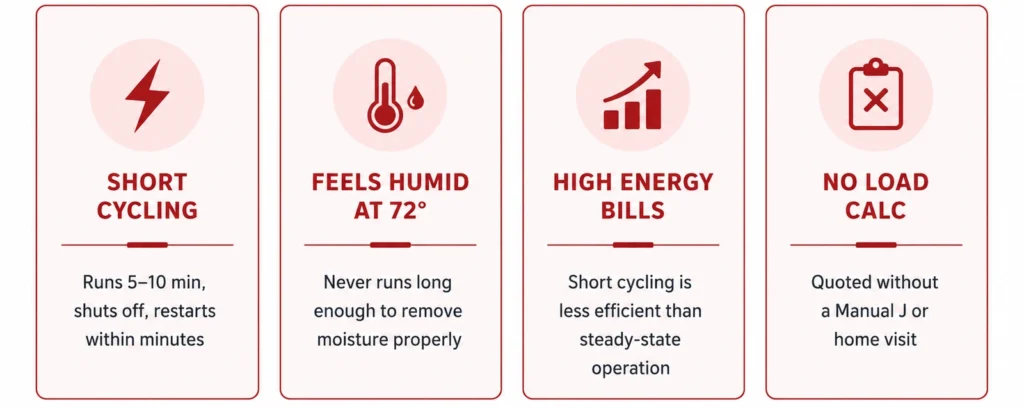
Common warning signs that an HVAC system may be oversized for the home.
An Oversized System Short Cycles 30% – 50% More Than an Appropriately Sized System;
dramatically increasing compressor wear, and reducing humidity control. Manual J analysis is required.
📊 By the Numbers
An oversized system short-cycles 30–50% more frequently than properly sized equipment, dramatically increasing compressor wear and reducing humidity control effectiveness. In Northern Virginia’s high-humidity environment, this compounds into mold risk, early system failure, and persistent indoor discomfort that replacing the same-sized unit will not fix.
| Oversizing Warning Sign | What It Actually Means |
|---|---|
| Short cycling | Runs 5–10 minutes, shuts off, then restarts within minutes. The system never completes a full dehumidification cycle. |
| Feels humid at 72°F | The system cools the air quickly but does not run long enough to remove moisture properly. |
| Bills higher than similar neighbors | Short cycling is significantly less efficient than longer, steady-state operation. |
| Installed without a load calculation | If the contractor quoted the system without visiting your home, a proper Manual J load calculation was not performed. |
| Humidity problems worsened after replacement | This commonly happens when the replacement system uses the same oversized tonnage as the equipment that failed. |
| Installed during a renovation or addition | Contractors sometimes increase system size “to be safe,” which can create an oversized system and new comfort problems. |
When You Should Repair Instead of Replace Your HVAC System
The cases where repair is clearly the right move — and why we’ll always tell you
Most HVAC companies benefit financially from replacement. We benefit from your trust. These are the situations where we will always recommend repair over replacement — even if a new system would be an easier sale.
🔍 When NOT to Replace
When replacement is not the right move:
- Single failed capacitor ($200–$400 repair) — never justifies a $14,000 replacement.
- Clogged condensate drain — a vinegar flush or $150 service call, not a new system.
- High static pressure causing poor performance — a duct fix, not an equipment fix.
- System under 10 years old with no compressor failure — single-component failures are normal wear.
- Hot upstairs in a townhome — this is typically stack effect and airflow, not an undersized system.
- Musty basement smell — this is a moisture-management problem, not an HVAC failure.
If we find any of these during your audit, we will tell you — and we will fix the actual problem.
Northern Virginia HVAC Guide: Repair vs. Replace
How to make this decision honestly in Northern Virginia’s climate
The Northern Virginia HVAC Guide recommends evaluating the entire system before deciding whether to repair or replace the equipment.
Repair vs Replace - A Northern Virginia HVAC Decision Framework
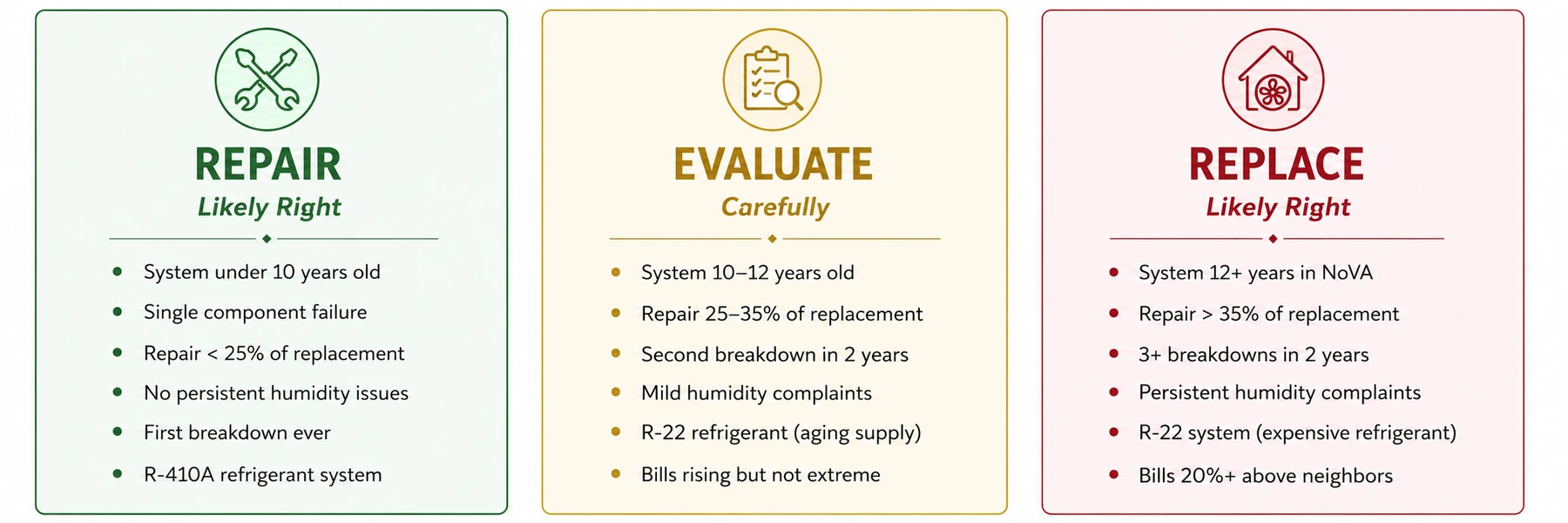
A practical guide for deciding whether to repair, carefully evaluate or replace an HVAC system.
| Decision Factor | NOVA-Specific Guidance |
|---|---|
| Age | Under 10 years: repair is almost always the right move. At 10–12 years, the decision depends on repair cost and service history. At 12+ years, replacement should be evaluated seriously. |
| Repair cost as a percentage of replacement | Under 25%: repair. Between 25–35%: evaluate carefully. Above 35%: replacement is usually the better financial decision. |
| Humidity complaints | Persistent humidity despite normal system operation often signals oversizing. A properly sized replacement may solve the underlying problem. Do not keep repairing an oversized system indefinitely. |
| Recent breakdown frequency | One failure is normal wear. Two failures within 12 months indicate a pattern. Three or more breakdowns usually signal broader system decline. |
| Refrigerant type | R-22 systems, generally installed before 2010, face increasingly expensive refrigerant costs as supply continues to shrink. This can shift the repair-versus-replace decision significantly toward replacement. |
| Energy bill trend | Bills rising 10–15% annually without increased usage may indicate a deteriorating system. A high-efficiency replacement may recover its added cost through energy savings within approximately five to seven years. |
Northern Virginia HVAC Guide: Current HVAC Costs
What HVAC work actually costs in Northern Virginia — and why national averages don’t apply
The cost section of this Northern Virginia HVAC Guide uses local conditions rather than misleading national averages. Northern Virginia HVAC costs exceed national averages for three compounding reasons: labor rates, permit requirements, and the transition to A2L low-GWP refrigerants. Historic home access in Old Town and similar neighborhoods adds $1,000–$2,000 to standard installation costs.
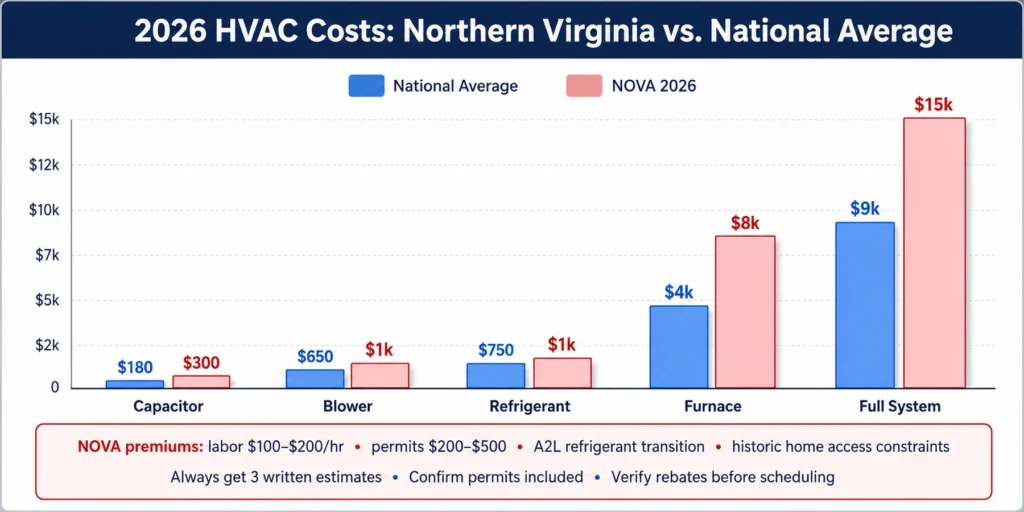
Estimated 2026 HVAC costs in Northern Virginia compared with national averages.
| Service | 2026 NOVA Range |
|---|---|
| Capacitor replacement | $200–$400 |
| Blower motor replacement | $600–$1,400 |
| Refrigerant repair (A2L systems, 2026) | $900–$2,500+ |
| Evaporator coil replacement | $1,200–$2,800 |
| Air handler replacement | $2,000–$4,500 |
| AC + gas furnace system (2,000 sq. ft.) | $8,500–$14,000 |
| Heat pump system (2,000 sq. ft.) | $9,500–$17,000 |
| Full system replacement (2,000 sq. ft. average) | $13,000–$18,000+ |
| Full system replacement (3,500+ sq. ft.) | $17,000–$25,000+ |
| Duct replacement in older Alexandria or Springfield homes | $2,100–$5,500 |
| Zoning system installation | $2,500–$5,000 |
| Whole-home dehumidifier installation | $1,400–$2,800 |
| Historic-home access premium in Old Town and similar areas | $1,000–$2,000 above standard |
📋 Cost Data Sources
2026 cost ranges based on current Northern Virginia labor rates ($100–$200/hr), active permit fee schedules ($200–$500), and A2L refrigerant transition pricing. System cost ranges corroborated by Angi/Fuse 2026 NOVA project data. Historic home premium based on documented Old Town and Rosemont installation constraints. Ranges vary by home size, efficiency tier, electrical upgrade needs, and duct condition.
| Rebate / Incentive Program | 2026 Status & Details |
|---|---|
| Federal IRA Tax Credit | Up to $2,000 for qualifying high-efficiency heat pumps and air-conditioning systems. The credit is claimed on the homeowner’s federal tax return and is currently available through 2032. |
| Virginia HOMES / HEAR Rebates | Potential rebates of $8,000–$14,000 for qualifying whole-home energy retrofits. The programs have been approved, but rollout has been delayed while final implementation is completed. Verify the current status with the Virginia Department of Energy before including these rebates in your project budget. |
| Utility Rebates | Columbia Gas and other utilities may offer rebates of $300 or more for qualifying high-efficiency furnaces and related equipment. Confirm current eligibility requirements, expiration dates and available funding before scheduling installation. |
| Fairfax County Energy Rebates | Potential incentives of $500–$1,000 may be available for qualifying energy audits and residential efficiency improvements. Check Fairfax County’s current program availability and requirements before budgeting for the work. |
Rebate programs change without notice. Always verify current program status and eligibility before scheduling work — do not budget around rebates that may have changed. We check eligibility during every evaluation.
Always get 3 written estimates. Always confirm permits are included — unpermitted HVAC work in Virginia creates legal and resale complications. Always ask whether duct assessment is included in any replacement quote.
Frequently Asked Questions
12 questions NOVA homeowners actually search for — with complete answers
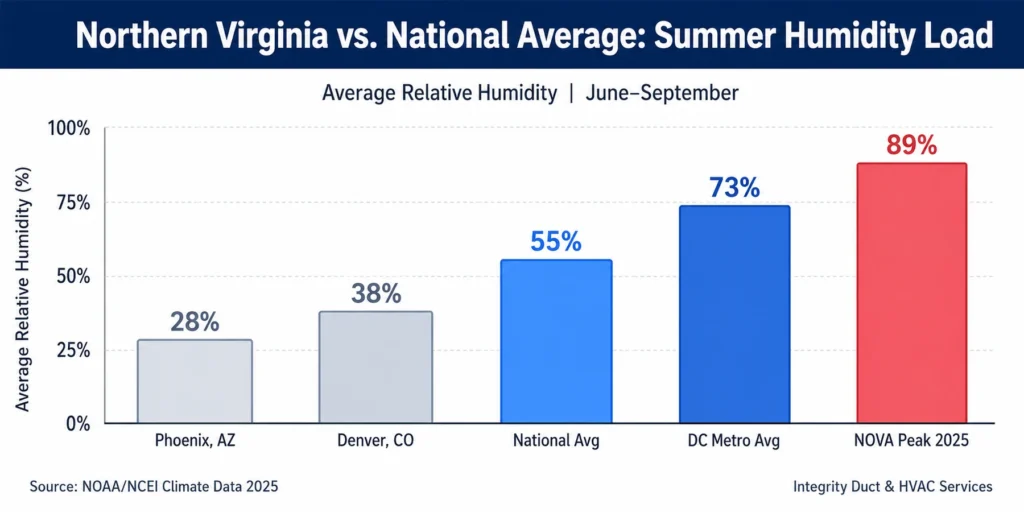
Northern Virginia experiences a substantially higher summer humidity load than the national average.

What to Ask Every HVAC Company
Six questions that separate qualified contractors from the rest
Most Northern Virginia homeowners call two or three contractors when facing significant HVAC repair or replacement. These six questions give you a framework to evaluate each on substance — not just price.
| Question | Why It Matters |
|---|---|
| Are you Virginia Class A licensed? | This is a legal requirement in Virginia. Ask for the contractor’s license number and verify it through the Virginia DPOR website. Any hesitation is disqualifying. |
| Will you perform a Manual J load calculation? | A Manual J is required for accurate system sizing. If the contractor has not visited your home before quoting a replacement, the answer is no — and the quote is unreliable. |
| Will you measure static pressure? | Static-pressure testing identifies duct restrictions that cause uneven cooling, high energy bills, excessive noise and premature equipment failure. Many contractors skip this entirely. |
| Are your technicians NATE certified? | NATE, or North American Technician Excellence, validates technical competence beyond state licensing. Ask for documentation. |
| Will permits be pulled? | Permits are required for most HVAC replacements in Virginia. Unpermitted work can create resale problems and may jeopardize manufacturer warranty coverage. |
| Will you provide a written, itemized estimate? | Any contractor unwilling to put the complete quote in writing should not receive your business. |
Red Flags to Watch For
| Red Flag | What It Actually Means |
|---|---|
| No duct inspection included in the quote | Duct problems are the root cause of many Northern Virginia HVAC complaints. Quoting replacement equipment without evaluating the duct system is incomplete work. |
| Immediate replacement recommendation | Recommending replacement before diagnosing the root cause prioritizes revenue over your interests. |
| No written estimate | Verbal quotes are difficult to enforce and can change after work begins. |
| No mention of permits | The legal, warranty and resale consequences of unpermitted work fall on the homeowner — not the contractor. |
| No site visit before the quote | Accurate sizing is impossible without inspecting the home. Rule-of-thumb sizing frequently produces oversized systems. |
| Price significantly below every other estimate | In a market where full-system replacement commonly costs $13,000–$18,000, a $7,000 quote usually means important items are missing or lower-grade equipment and installation practices are being used. |
Why Integrity Duct & HVAC Services?
What makes the diagnostic approach different from most NOVA contractors
We Diagnose the Whole System — Not Just the Equipment
Most HVAC companies diagnose from the unit. We diagnose from the whole system — measuring static pressure, calculating actual load, and mapping airflow before recommending anything.
That is why our solutions fix root causes rather than replacing equipment that was never the real problem.
We have helped Burke homeowners avoid $14,000 replacements by identifying duct restrictions. We have solved Fort Hunt basement mold problems that three previous contractors blamed on AC failure. We have fixed hot third floors in Kingstowne with zoning instead of unnecessary new equipment.
If you want data before decisions, this is how we work.
| Trust Standard | What It Means for You |
|---|---|
| BBB A+ Rated | A documented track record of professional service and customer accountability throughout Northern Virginia. |
| Virginia Class A Licensed | Full legal compliance, proper insurance and the credentials required to perform residential HVAC work in Virginia. |
| Manual J Load Calculations | Every replacement system is properly sized for the home — not estimated from square footage or copied from the old equipment. |
| Static Pressure Testing | Every evaluation includes an assessment of duct resistance, airflow restrictions and overall system performance. |
| Written Documentation | You receive clear findings and recommendations in writing rather than relying on a verbal summary. |
| NATE-Certified Technicians | Independent technical validation that goes beyond basic state licensing. |
Northern Virginia HVAC Customer Reviews
“We almost replaced our entire system. The audit found two duct restrictions. Fixed for a fraction of the cost.”— Burke Homeowner
“Zoning upgrade in our Kingstowne townhome dropped our bills 15% and fixed the hot upstairs permanently.”— Mike R., Kingstowne
“Three contractors said we needed a new AC. Integrity found our basement moisture load was the actual issue. A dehumidifier solved it completely.”— Fort Hunt Homeowner
“Our historic Old Town row home has duct constraints most companies won’t touch. Integrity redesigned the airflow without tearing anything up.”— Old Town Homeowner
“We interviewed four contractors in Vienna. Integrity was the only one who measured static pressure and performed a load calculation before quoting.”— Vienna Homeowner
After reviewing this Northern Virginia HVAC Guide, the next step is to determine what is actually happening inside your home through measured humidity, airflow, static-pressure, and load data.
Schedule Your Free Humidity & Airflow Audit
If your home feels muggy, your upstairs runs hot, your bills are climbing, or your system is 10+ years old — this is the right first step.
During your audit: static pressure measurement • indoor humidity assessment • duct leakage evaluation • return sizing review • load calculation check. You receive a documented report. No sales pressure. Just data.
Serving: Alexandria (22301–22315) • Arlington County • Fairfax County • Falls Church • McLean • Vienna • Reston • Burke • Springfield • Centreville • Chantilly • Herndon • Great Falls • and surrounding Northern Virginia communities
Integrity Duct & HVAC Services serves homeowners throughout Alexandria, Arlington County, Fairfax County, Fairfax City and Falls Church, including Old Town, Del Ray, Rosemont, Arlandria, Springfield, Burke, Reston, Centreville, Chantilly, Lorton and surrounding Northern Virginia communities.
Related Northern Virginia HVAC Resources
Integrity Duct & HVAC Services
HVAC Contractor Alexandria, VA
(571) 351-7391
https://integrityductandhvacservices.com
BBB A+ Rated | NATE-Certified Technicians | 5-Star Google Reviews