
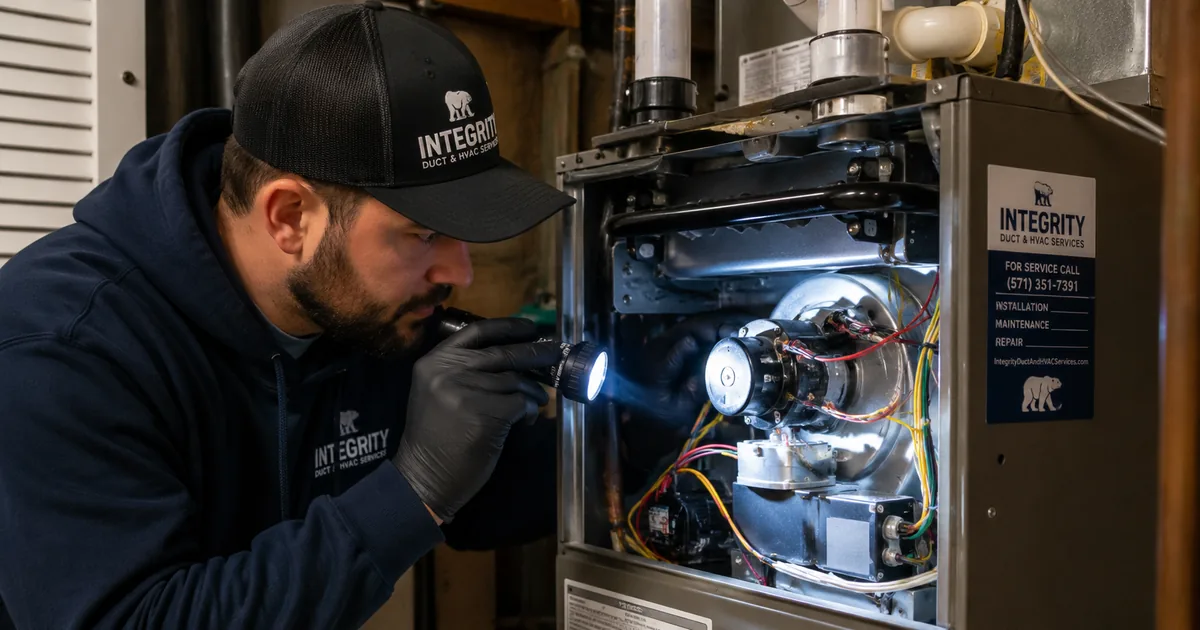
Furnace Making Loud Noise? What Each Sound Means
- August 4, 2026
Furnace Making a Loud Noise? What Each Sound Means
Published and technically reviewed by
Integrity Duct & HVAC Services, NATE-Certified HVAC Technicians – Alexandria, Virginia
If your furnace is making loud noise, do not ignore a new boom, grinding sound, sharp squeal or electrical buzz. Some noises come from expanding ductwork or restricted airflow. Others can signal delayed ignition, a failing blower motor or an electrical problem that requires the furnace to be shut down.
You know your home’s normal soundtrack: the thermostat clicks, the burners light, and warm air begins moving through the vents. When the furnace suddenly sounds like someone dropped a toolbox in the utility room, something has changed.
If your HVAC system is making unexplained noises, contact a trusted HVAC contractor in Alexandria, VA for a professional diagnosis before a minor problem becomes a major repair.
Quick Furnace Noise Diagnosis Guide
Safety First: Know When to Leave and Call for Help
Leave the home immediately if you smell natural gas, hear gas escaping, or a carbon monoxide alarm sounds. Do not operate the thermostat, lights, appliances, phones, or anything that could create a spark while inside.
From a safe location, call 911. Northern Virginia customers may also call the Washington Gas Emergency Leak Line at 844-WASHGAS (844-927-4427), option 1.
Turn the furnace off and call a qualified HVAC professional if you hear a forceful boom during ignition, grinding metal, violent shaking, or loud electrical buzzing—especially if accompanied by smoke, sparks, soot, or a burning odor.
This guide is for general information only. Furnace noises can have multiple causes and cannot be safely diagnosed by sound alone.
| Furnace Sound | Most Likely Area | How Urgent Is It? | Safe Homeowner Check? |
|---|---|---|---|
| Boom at startup | Burners or ignition system | Turn it off | No |
| Grinding or scraping | Blower wheel or motor | Turn it off | No |
| Squealing or screeching | Blower motor, bearings or belt | Prompt service | No |
| Rattling or clanking | Panel, inducer, blower or ductwork | Moderate to high | Exterior panel only |
| Buzzing or loud humming | Motor or electrical component | Moderate to high | No |
| Whistling | Filter, return-air restriction or duct leak | Moderate | Filter and vents |
| Repeated clicking | Ignition or control system | Moderate to high | Thermostat only |
| Popping in walls or ceilings | Expanding ductwork or airflow pressure | Usually low to moderate | Filter and vents |
This table provides initial triage—not a final diagnosis. Two different furnace problems can make remarkably similar sounds. What matters most is where the sound begins and when it occurs during the heating cycle.
Which Furnace Noises are Normal During Alexandria Winters?
A furnace does not operate silently. Normal sounds may include:
- One or two clicks before ignition
- A soft rush as the burners light
- A steady blower hum
- Air moving through supply registers
- Light ticking after the furnace starts or stops
- An occasional pop as sheet-metal ductwork warms or cools
Northern Virginia homes can cycle between long overnight heating periods and shorter daytime cycles as outdoor temperatures change. In older Alexandria houses and townhouses, rigid metal ductwork running through tight floor and wall cavities may expand, contract and transmit noise throughout the home.
That is why the location of the sound matters.
A dull pop inside a ceiling or wall may be ductwork. A forceful boom from inside the furnace cabinet at the exact moment the burners ignite requires immediate attention.
Furnace Making a Loud Noise? Before Calling, Notice These 3 Details
A technician will be better able to narrow down the problem if you can answer:
- Does the noise occur at ignition, when the blower begins, throughout the cycle or after shutdown?
- Is the sound coming from the furnace cabinet, a nearby duct or one particular register?
- Has the furnace also started producing less heat, cycling repeatedly or emitting an odor?
Record a short video from a safe distance when possible. Do not remove furnace panels or repeatedly restart the system simply to capture the sound.
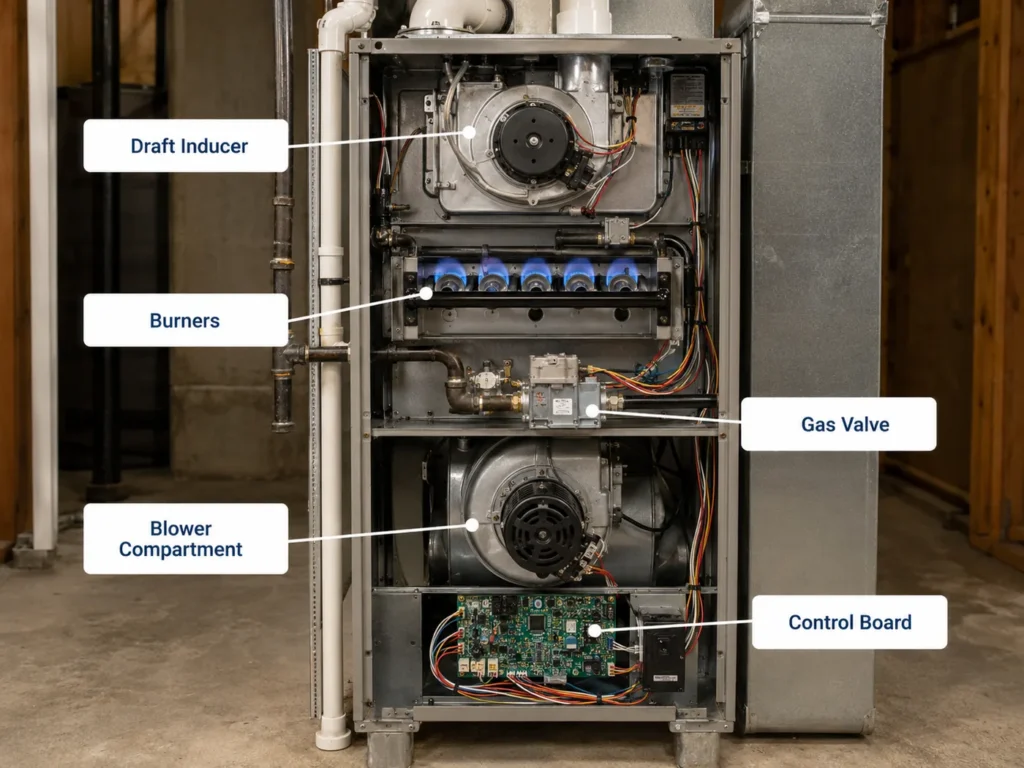
The location and timing of the noise can help distinguish an ignition problem from a blower, inducer or airflow issue.
Loud Boom at Startup: Possible Delayed Ignition
A loud boom or explosion-like sound when a gas furnace starts may indicate delayed ignition.
During normal operation, the gas should ignite promptly. When ignition is delayed, gas can briefly accumulate before lighting, creating a sudden boom. Possible causes include dirty burners, obstructed burner crossover ports, an ignition problem, burner misalignment or improper combustion.
A sudden bang at furnace startup needs immediate professional attention.
Turn the furnace off. Do not keep restarting it to see whether the noise happens again.
From the Field: Location Changes the Diagnosis
When a homeowner reports a “bang,” the first useful distinction is whether it came from the burner compartment or from the ductwork. A burner-area boom is treated as a combustion concern. A lighter pop farther inside the house may be expanding sheet metal or excessive duct pressure.
What to listen for: A delayed-ignition sound is typically a sudden, forceful boom occurring as the burners light. Duct expansion is more often a dull pop from a wall, ceiling or register after heated air begins moving.
An audio clip can help you describe the problem. It cannot confirm that a gas furnace is safe to operate.
Squealing or Screeching: Blower Motor Trouble
A high-pitched squeal often points toward the blower assembly.
The blower wheel—sometimes called a squirrel cage—moves heated air from the furnace into the duct system. Depending on the furnace’s age and design, squealing may involve:
- Worn blower-motor bearings
- A slipping belt on older belt-driven equipment
- A loose or misaligned blower wheel
- A failing permanent split capacitor, or PSC, motor
- A failing electronically commutated motor, or ECM, module
- The blower wheel rubbing against its housing
Manufacturers identify squealing and screeching as common signs of blower-motor or bearing trouble.
The furnace may continue producing heat for a while, but that does not mean the problem is harmless. A deteriorating motor can eventually stop, overheat or leave the furnace unable to circulate warm air.
What a Technician Listens For
A squeal that begins only when the blower starts—and rises or falls with fan speed—directs attention toward the motor, bearings, wheel and mounting assembly. A whistle heard mainly at the return grille points more toward airflow restriction.
What to listen for: A sharp, continuous pitch that begins when the blower turns on and changes as the fan reaches operating speed.
Schedule service promptly. Shut the furnace down if the squeal becomes severe or is accompanied by smoke or a hot electrical smell.
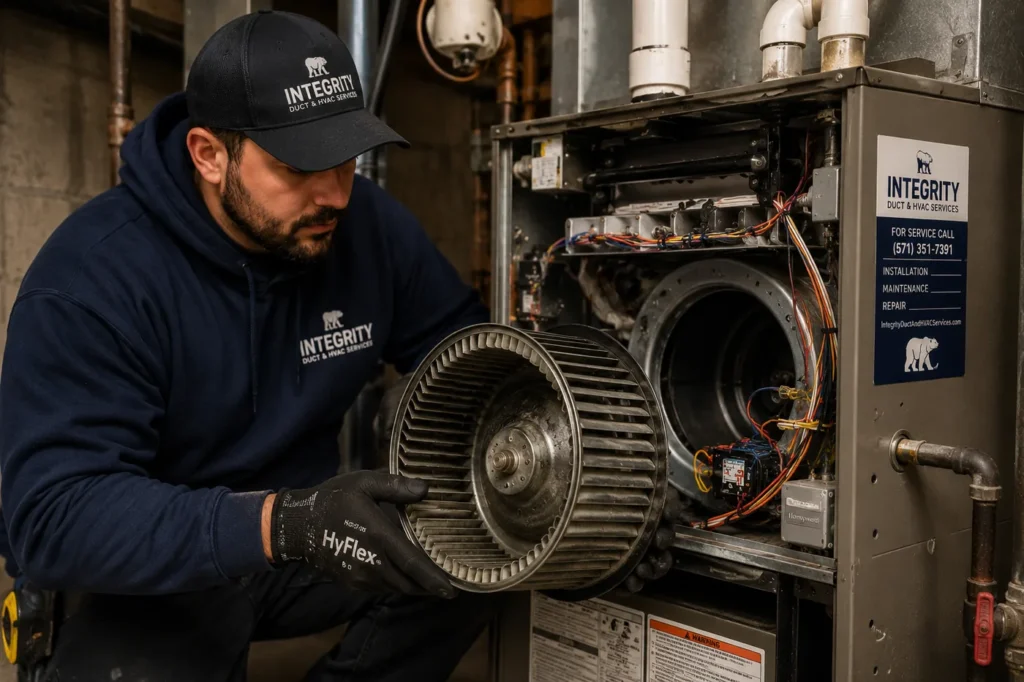
Squealing, grinding and scraping noises often originate within the furnace blower assembly.
Grinding or Scraping: Blower Wheel or Motor Failure
Grinding, scraping or metal-on-metal noise is not normal.
Possible causes include:
- A loose blower-wheel set screw
- A bent or damaged squirrel cage
- A blower wheel contacting its housing
- Failing motor bearings
- A shifted motor mount
- Debris inside the blower compartment
Continuing to run the furnace may damage the blower wheel, motor or housing and turn a limited repair into a larger one.
Turn the system off and arrange professional heating repair.
Do not reach inside the blower compartment. The wheel may begin moving unexpectedly, and electrical components can remain hazardous even after the furnace has been switched off.
Rattling or Clanking Inside the Furnace Cabinet
A light rattle may be nothing more than an exterior panel that is not properly seated. A deeper clank, rapid vibration or sound that worsens with each cycle can indicate an internal problem.
Common sources include:
- A loose blower wheel
- A failing draft inducer motor
- A damaged inducer wheel
- Loose motor mounts
- A vibrating vent or flue connection
- Loose cabinet hardware
- Debris contacting a moving component
The draft inducer starts before the burners and helps move combustion gases through the venting system. If the rattling begins before ignition, the inducer or venting assembly may be involved. If it begins when warm air starts moving, the blower or duct system becomes more likely.
You may confirm that the exterior furnace panel is properly seated. Do not remove the burner compartment or reach inside the cabinet.
Buzzing or Loud Humming: Electrical or Motor Problems
A quiet, steady hum may be normal. A new, loud or intermittent buzz is not.
Possible causes include:
- A blower motor struggling to start
- A failing run capacitor on a system that uses one
- A transformer vibration
- A sticking relay
- A loose electrical connection
- A failing inducer motor
- An ECM motor-module problem
- A loose cabinet or duct panel
A furnace that hums or buzzes but does not start may have a seized motor or failed capacitor.
Turn the system off immediately if buzzing is accompanied by:
- Smoke or sparking
- A burning-electrical odor
- Repeated circuit-breaker trips
- A motor that hums without turning
- Intermittent loss of heat
Do not open electrical compartments or attempt to test capacitors. A capacitor can retain an electrical charge after power has been disconnected.
Whistling: Restricted Airflow or Return-Air Problems
Whistling usually indicates that air is being pulled through a restricted opening or escaping through a small gap.
Common causes include:
- A clogged furnace filter
- A filter that is too restrictive for the system
- A blocked return grille
- Furniture covering a return
- Air leaking around the filter rack
- A loose duct seam
- Undersized return ductwork
- Excessive static pressure
A dirty filter can significantly reduce airflow, increase furnace run time and place additional wear on the blower motor.
Check that the filter is the correct size, installed in the proper direction and not visibly clogged. Make sure supply registers are open and furniture, boxes or curtains are not blocking return grilles.
Do not operate the furnace without a filter.
Northern Virginia Airflow Cue
Many multilevel townhouses and older detached homes have limited return-air pathways. If the whistle changes when an interior door opens or when a return grille is uncovered, tell the technician. That detail may point toward a pressure or return-air problem rather than a failing furnace component.
Persistent whistling may require professional furnace diagnosis and repair to measure system static pressure and inspect the return-air pathway.
Repeated Clicking but No Heat
One or two clicks can be part of a normal furnace startup. Repeated clicking without ignition usually means the system is attempting—and failing—to complete its sequence.
Possible causes include:
- A damaged igniter
- A dirty or failing flame sensor
- A pressure-switch problem
- A control-board relay
- A gas-valve problem
- Low-voltage wiring trouble
- A blocked intake or exhaust pipe on a high-efficiency furnace
Confirm that the thermostat is set to Heat and that the requested temperature is above the current room temperature.
If the furnace keeps clicking without producing heat, stop repeatedly resetting it. A safety control may be preventing operation because the required conditions for safe ignition have not been met.
Popping or Ticking in Older Northern Virginia Ductwork
Light ticking or occasional popping after startup or shutdown often comes from sheet metal expanding and contracting.
Loud, frequent duct popping may point to:
- Excessive static pressure
- A clogged or restrictive filter
- Closed supply registers
- Loose or unsupported duct panels
- Undersized ductwork
- An airflow imbalance
- Missing duct reinforcement
This can become more noticeable when older ductwork is paired with newer equipment that moves air differently from the system it replaced.
The furnace itself may be operating, but excessive airflow pressure can still increase noise, reduce comfort and strain the blower.
What to listen for: A dull pop from a wall, floor or ceiling shortly after the blower begins moving air—not a forceful boom from inside the furnace cabinet.
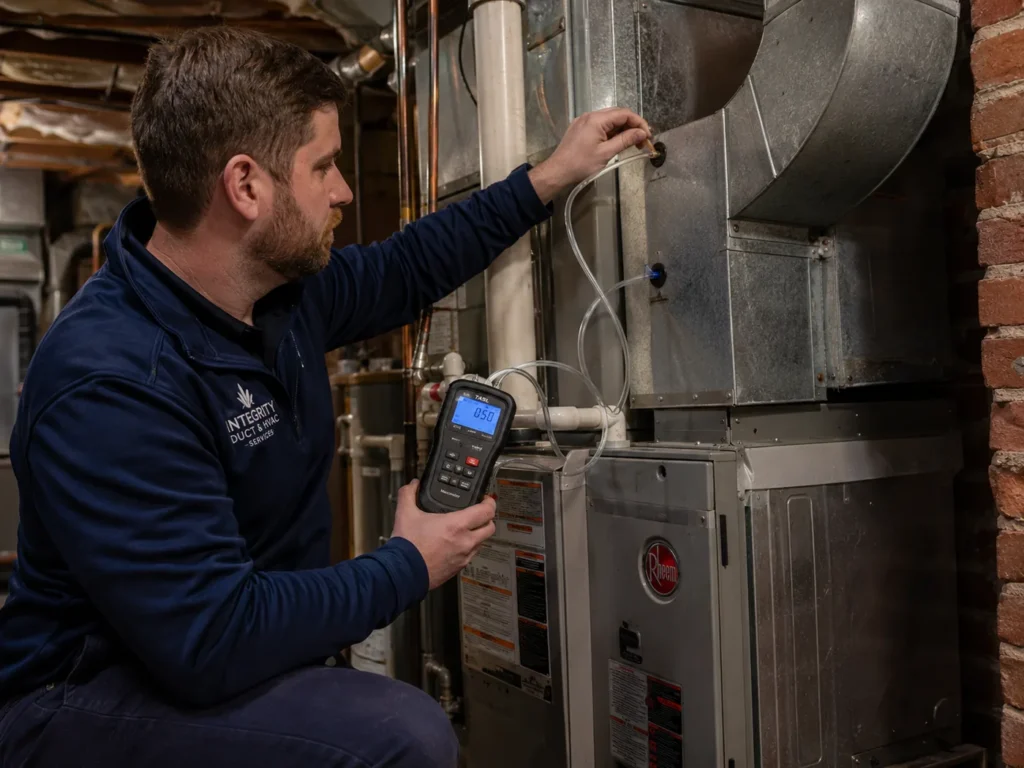
Static-pressure testing can help determine whether loud popping or whistling is being caused by restricted airflow or undersized ductwork.
Can You Keep Running a Noisy Furnace?
It depends on the sound. Use this guide to decide whether to shut the system down, schedule service, or continue monitoring it.
Turn It Off Immediately
- Booming at ignition
- Grinding or metal scraping
- Violent shaking
- Smoke or sparks
- A burning-electrical odor
- A gas odor
- A carbon monoxide alarm
- Loud buzzing accompanied by failed startup
Schedule Prompt Service
- Squealing or screeching
- Repeated clicking
- New rattling or clanking
- Buzzing without smoke or odor
- Whistling after checking the filter and vents
Monitor, but Do Not Ignore
- Light ticking after shutdown
- Occasional duct popping
- A soft, steady blower hum
- One or two startup clicks
A furnace does not have to stop producing heat before it is failing.
Safe DIY Furnace Checks for Homeowners
You Can Safely Check
- Confirm that the thermostat is set to Heat.
- Inspect and replace a visibly dirty filter.
- Open closed supply registers.
- Remove furniture or belongings blocking return grilles.
- Confirm that the exterior furnace panel is seated.
- Note exactly when the noise starts and stops.
- Record a short audio or video clip from a safe distance.
- Check whether the furnace is producing normal heat.
Do Not Attempt
- Open the burner compartment.
- Clean or adjust burners.
- Bypass a safety switch.
- Touch electrical terminals.
- Test capacitors.
- Reach near the blower wheel.
- Adjust the gas valve.
- Repeatedly reset a malfunctioning furnace.
These checks are limited to exterior, low-risk observations. If the furnace is booming, grinding, sparking, smoking, or producing a gas odor, shut it down and seek professional help.
When Should You Call Integrity for a Furnace Making a Loud Noise
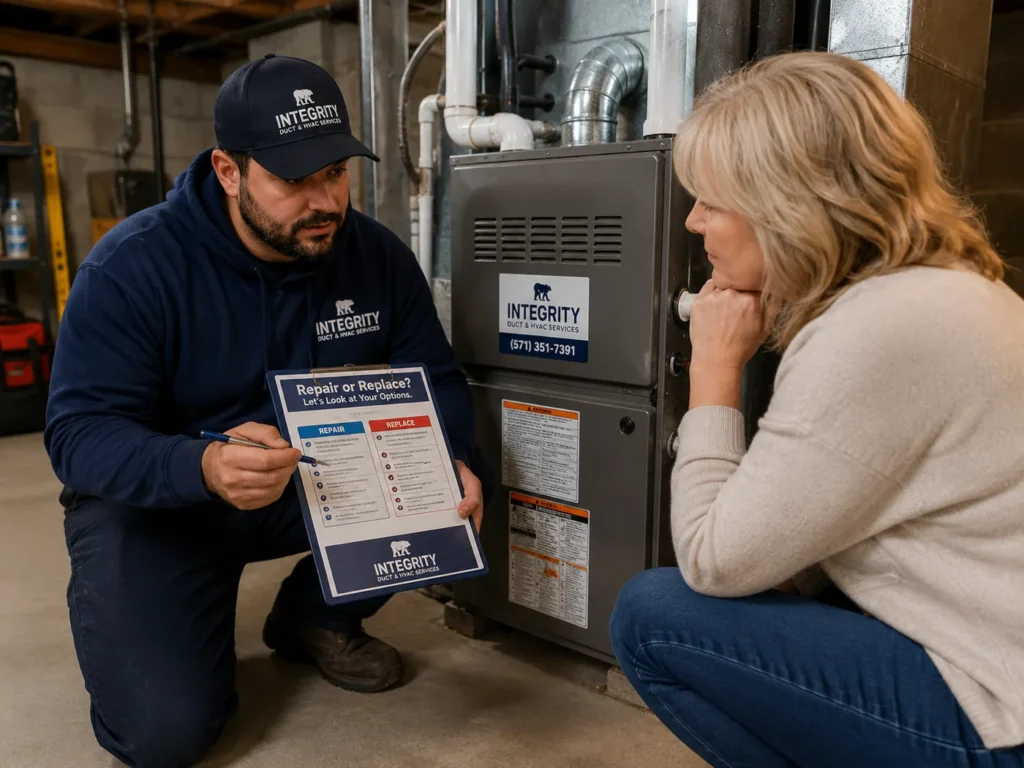
Furnace age, repair history and the cost of the failed component all matter when deciding whether to repair or replace the system.
A noisy furnace may keep running temporarily, but delaying diagnosis can allow a loose blower wheel, failing motor, inducer problem or ignition issue to cause additional damage.
The right decision also depends on the age and overall condition of the equipment. Review our guide (how long furnaces typically last) to see whether your system may be nearing the end of its expected service life. If the repair is expensive or the furnace has become unreliable, compare the long-term costs before putting more money into an aging system. If your furnace is making a loud noise, call us today for a free diagnosis and evaluation.
Integrity Duct & HVAC Services provides professional heating repair in Alexandria, VA, including:
- Furnace banging and delayed-ignition diagnosis
- Blower-motor and squirrel-cage repair
- Draft-inducer troubleshooting
- Electrical buzzing and startup failures
- Restricted airflow and static-pressure testing
- Clicking furnaces that will not ignite
- Loud or unstable ductwork
- Combustion and carbon-monoxide concerns
We serve homeowners throughout Alexandria, Mount Vernon, Fort Hunt, Hollin Hall, Hybla Valley, Old Town, Del Ray, Kingstowne, Franconia and nearby Northern Virginia communities.
Integrity Duct & HVAC Services
Alexandria, VA
BBB A+ Rated | NATE-Certified Technicians | 5-Star Google Reviews | Member, Alexandria Chamber of Commerce
Frequently Asked Questions
Is a loud furnace dangerous?
It can be. Light ticking or occasional duct popping may be normal, but booming at ignition, grinding, scraping, persistent electrical buzzing or any noise accompanied by gas odor, smoke or a carbon monoxide alarm requires immediate attention.
Why does my furnace make a loud bang when it starts?
A boom from inside the furnace may indicate delayed ignition. A dull pop from a wall or ceiling may come from expanding ductwork. Turn the furnace off if the sound is forceful or appears to originate near the burners.
Can a dirty furnace filter cause loud noise?
Yes. A dirty or overly restrictive filter can reduce airflow, create whistling, increase blower noise and contribute to excessive static pressure.
Why is my furnace squealing?
Squealing may come from worn blower-motor bearings, an older belt-driven blower, a loose squirrel cage or a failing PSC or ECM blower motor.
Should I run a furnace that is grinding?
No. Grinding or metal-on-metal scraping may indicate a damaged blower wheel or failing motor bearings. Turn the furnace off and schedule repair.
Why does my furnace click repeatedly without turning on?
Repeated clicking may indicate that the ignition sequence is failing because of an igniter, flame sensor, pressure switch, control board, gas valve or venting problem.
Is duct popping dangerous?
Occasional light popping is usually caused by sheet-metal expansion. Loud or frequent popping may indicate restricted airflow, excessive static pressure or unsupported ductwork and should be evaluated.

About Integrity Duct & HVAC Services: Integrity Duct & HVAC Services provides residential and commercial heating, air conditioning, indoor air quality, ductwork, maintenance, repair, and system replacement services in Alexandria, VA and throughout Northern Virginia. This article was reviewed for technical accuracy by Integrity’s NATE-certified HVAC team.
Integrity Duct & HVAC Services provides AC diagnostics, repairs, maintenance and system replacement throughout Alexandria and Northern Virginia.
Integrity Duct & HVAC Services
Alexandria, Virginia
No. 2705191210
No. 2710081728
BBB A+ Rated | NATE-Certified Technicians | 5-Star Google Reviews | Member, Alexandria Chamber of Commerce
HVAC Services and Resources for a More Comfortable Home
A furnace that makes unnatural noises may require immediate professional diagnosis and repair; both for safety and for comfort purposes. Integrity Duct and HVAC Services is proud to offer Furnace and emergency services, in addition to the below HVAC services.
AC Repair in Alexandria
Get professional diagnosis for an AC that runs continuously, blows warm air, freezes up, leaks, or struggles to reach the set temperature.
Explore AC Repair → ⚙HVAC Maintenance
Seasonal maintenance helps identify dirty coils, restricted airflow, drainage problems, and worn components before they cause a breakdown.
View Maintenance Guidance → ◈HVAC Installation
Explore properly sized, energy-efficient replacement options when an older system can no longer maintain comfort reliably.
Explore HVAC Installation → ≋Duct Cleaning and Ventilation
Address dust, debris, and airflow concerns within the duct system to support cleaner circulation and more consistent home comfort.
Explore Duct Services → ⌁Indoor Air Quality
Improve filtration, humidity control, and indoor comfort with solutions selected for the conditions inside your home.
Explore Air Quality Solutions → !Emergency HVAC Repair
Get help when your system stops cooling, freezes repeatedly, leaks water, or shows signs of a serious electrical or mechanical failure.
View Emergency HVAC Service →Explore the Northern Virginia HVAC Guide
Learn more about HVAC repairs, replacement costs, system sizing, humidity, airflow, energy efficiency, and home-comfort concerns throughout Alexandria and Northern Virginia.