

Hot Upstairs Townhouse? Why Alexandria Homes Overheat in Summer
- July 12, 2026
Hot Upstairs Townhouse? Why Alexandria Homes Overheat in Summer
If your townhouse upstairs is always hot in the summer, you are not imagining it. In many Alexandria, VA townhomes, the basement feels cold, the main level feels fine, and the top-floor bedrooms feel like a sauna by bedtime.
This is one of the most common comfort complaints in multi-level homes across Old Town, Del Ray, Rosemont, Cameron Station, Kingstowne, Potomac Yard, Landmark, Franconia, and nearby Northern Virginia communities.
Most of the time, a hot upstairs townhouse is not caused by one simple thermostat setting. This guide explains the hidden building physics behind an overheating multi-level home, what you can try first, and when the problem requires professional diagnostics.
Why Upper-Level Rooms Overheat in Alexandria Townhomes
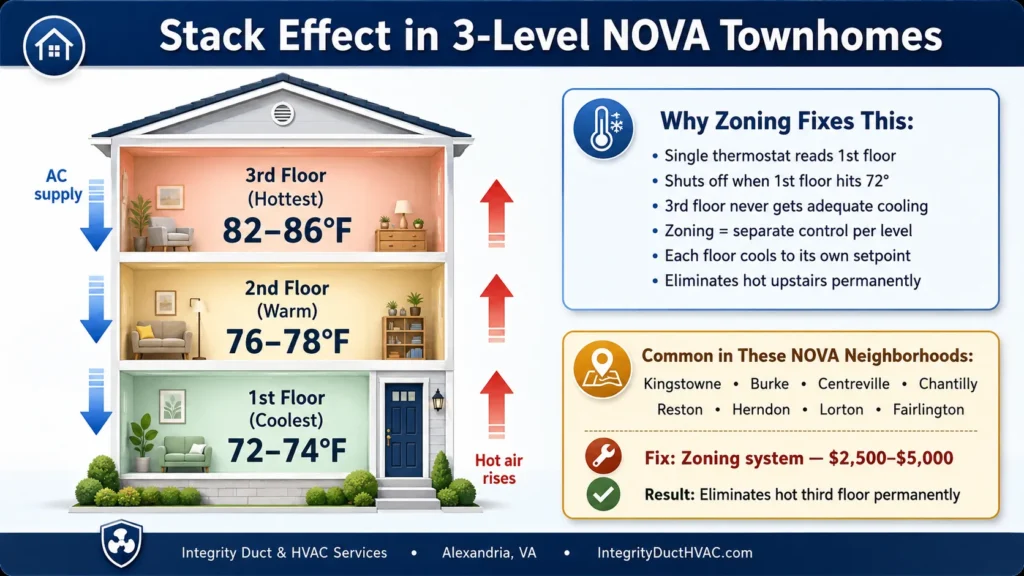
Warm air naturally rises through stairwells, wall cavities, open chases, and small gaps in the home’s framing. This is part of a building science principle known as the stack effect, sometimes called the chimney effect.
But stack effect is only part of the problem. In Alexandria townhouses, sweltering bedrooms are often made worse by poor duct design, weak return airflow, leaky duct joints, attic heat, and single-zone thermostat placement.
That is why the top floor can stay uncomfortable even when the air conditioner is running and the main living area feels fine.
1. Single-Zone HVAC Systems in Multi-Level Townhomes
Many Alexandria townhomes built in the 1990s and 2000s feature three or four finished levels but rely on one central HVAC system with one thermostat located on the main living level. Once that main floor reaches the target temperature, the system shuts off.
The flaw in this setup is obvious: the thermostat has no idea the upstairs bedrooms are still baking.
In a hot upstairs townhouse, thermostat location matters almost as much as the equipment itself. This setup is common in three- and four-level models throughout Kingstowne, Cameron Station, Potomac Yard, and Landmark. If the main floor feels fine but the top level stays hot, the home may need airflow balancing, zoning, or supplemental cooling.
2. Weak Return Air Traps Heat in Bedrooms
Air conditioning is a two-way street. The system must push cool air into a room, but it also has to pull warm air back out.
In a classic hot upstairs townhouse scenario, the upper level may have supply vents but not enough return air near the bedrooms. When bedroom doors close at night, stagnant warm air gets trapped, airflow slows down, and the room holds heat even while the AC is running.
This layout flaw regularly shows up in older Alexandria rowhouses, Del Ray homes with retrofitted ductwork, and mid-century brick townhomes where ducts were squeezed into tight plaster walls.
Pro tip: a professional HVAC inspection should check supply airflow, return duct sizing, static pressure, duct leakage, filter restrictions, coil condition, and the system’s temperature split. Without those metrics, any fix is just a guess.
3. Poor Attic Insulation Sends Radiant Heat Downward
Your roof absorbs direct Mid-Atlantic summer sun all day. If your attic is under-insulated, poorly air-sealed, or poorly ventilated, that heat can radiate down through the ceiling and into the top-floor bedrooms.
This can make the upper floor feel increasingly miserable as the evening goes on, especially in rooms directly under the roofline.
Air sealing matters just as much as insulation depth. Gaps around attic hatches, recessed lights, duct chases, plumbing penetrations, and knee walls can let hot attic air migrate into the living space.
4. Duct Obstructions and Leaks Starve the Top Floor
In many local townhome layouts, the indoor air handler sits in a basement, garage, utility closet, or lower level. Cool air has to travel through long vertical duct runs to reach the top floor.
That airflow can be reduced by:
Undersized or restricted ductwork
Crushed or kinked flex ducting
Disconnected duct joints or leaky seams inside wall cavities
Dirty air filters or clogged evaporator coils
Closed dampers or poorly balanced registers
This is why upgrading to a bigger AC unit rarely solves the problem. A larger system connected to flawed or restrictive ductwork can short-cycle, remove less humidity, and still leave the top floor hot.
5. Solar Heat Gain Bakes Specific Bedrooms
Townhomes usually have most of their window exposure on the front and rear facades. If an upstairs bedroom faces west or south, the late-afternoon sun can heat the window glass, furniture, flooring, and walls.
Blackout cellular shades, UV window film, exterior shading, and sealing air leaks around windows can help reduce that heat gain. But if the root cause is poor airflow or duct performance, window treatments alone will not provide permanent relief.
Furnace Still Blowing Cold Air?
If basic thermostat, filter, and airflow checks do not restore heat, a furnace blowing cold air may involve an ignition problem, safety shutdown, failed component, or another issue that needs professional diagnosis. If your home is continuing to lose heat, use our Alexandria emergency heating guide for homeowner checks, safety information, and priority heating service.
Quick Fixes for a Hot Upstairs Townhouse
Before investing in major equipment upgrades, try these steps to reduce the temperature split:
Replace your air filter if it has been in place for more than 30 to 90 days.
Make sure all upstairs supply vents are fully open and not blocked by furniture or drapes.
Keep upstairs bedroom doors open when possible to improve return air circulation.
Use blackout cellular shades during peak daytime hours on west- and south-facing windows.
Switch your thermostat fan setting to “on” instead of “auto” during the hottest afternoon hours to keep air mixing between floors.
Partially reduce basement airflow only if the system stays quiet and airflow remains normal.
Never fully close multiple downstairs registers. While partially adjusting basement airflow can sometimes help redirect air upward, closing too many vents can create damaging static pressure problems, increase duct leakage, reduce system efficiency, or contribute to frozen AC coils.
If vents whistle, airflow gets noisy, or cooling gets worse, stop and schedule professional airflow balancing.
Best HVAC Fixes for a Hot Upstairs Townhouse
| Solution | Cost Level | Effectiveness | Best For |
|---|---|---|---|
| Airflow balancing | Low-Medium | Medium | Mild upstairs temperature splits of 2 to 4 degrees |
| Return air improvement | Medium | High | Bedrooms that overheat when doors are closed |
| Attic air sealing and insulation | Medium | High | Top-floor rooms directly under a hot roofline |
| Duct sealing or duct repair | Medium | High | Weak airflow from leaky joints or unsealed utility chases |
| HVAC zoning system | High | High | Three- or four-level townhomes with accessible ductwork |
| Ductless mini-split | High | Very High | Primary bedrooms, lofts, home offices, or historic properties |
The right fix depends on the cause. Some homes only need airflow balancing. Others need return air improvements, duct sealing, attic insulation, HVAC zoning, or a ductless mini-split for the top floor.
When to Call an HVAC Contractor in Alexandria, VA
If your upper level stays uncomfortable even though the central air conditioner is running, the filter is fresh, and the main floor feels fine, the issue is usually structural.
Can HVAC Maintenance Help With a Hot Upstairs Townhouse?
Regular HVAC maintenance can help prevent problems that make upstairs comfort worse, including dirty filters, clogged coils, weak airflow, low refrigerant, blocked condensate lines, and poor system performance during peak summer heat.
However, maintenance alone will not fix every hot upstairs townhouse. If the real issue is undersized ductwork, poor return air, attic heat, or a single-zone system trying to cool three or four levels, the home may still need airflow diagnostics, duct improvements, zoning, or supplemental cooling.
For homeowners who want seasonal inspections before the hottest months, Integrity Duct & HVAC Services offers HVAC service plans in Alexandria, VA to help keep systems clean, tested, and ready for Northern Virginia summer conditions.
Integrity Duct & HVAC Services can perform a diagnostic inspection on your Alexandria townhome. Our team can measure airflow, evaluate return and duct performance, check system static pressure, test AC performance, and identify why your home is trapping heat before you spend money on the wrong upgrade.
Integrity Duct & HVAC Services serves Alexandria, VA, including Old Town, Del Ray, Rosemont, Cameron Station, Kingstowne, Potomac Yard, Landmark, Franconia, and nearby Northern Virginia communities.
FAQs: Why Is My Townhouse Upstairs Always Hot?
Why is my townhouse upstairs always hot even when the AC is running?
An upstairs level may stay hot because of rising heat, weak supply airflow, poor return air, insufficient attic insulation, duct leakage, solar heat gain, or a single thermostat that shuts the system off before the top floor can cool down. If the AC is running but the upstairs still feels hot, the system needs a closer look.
Is it normal for upstairs bedrooms to be hotter than downstairs?
A minor temperature difference of 2 to 3 degrees is common in multi-level homes. However, if the upstairs is 8 to 15 degrees hotter, that is a strong sign of an underlying airflow, ductwork, insulation, return-air, or zoning issue.
Will closing downstairs vents make the upstairs cooler?
Partially adjusting airflow may help push a small amount of extra air upward, but fully closing multiple vents can restrict total system airflow. That can raise static pressure, lower efficiency, increase duct leakage, or freeze the AC coil. Professional airflow balancing is safer.
Does my Alexandria townhouse need HVAC zoning?
If your lower levels are comfortable but your top level is still hot, HVAC zoning may help. Zoning uses motorized dampers inside the ductwork and separate thermostats to direct cooling where it is needed most.
Are mini-splits good for hot upstairs bedrooms?
Yes. A ductless mini-split functions as an independent cooling system. It is one of the strongest solutions for a hot primary bedroom, top-floor office, loft space, or historic Old Town Alexandria property where modifying central ductwork is difficult.
Integrity Duct & HVAC Services
HVAC Contractor Alexandria, VA
(571) 351-7391
https://integrityductandhvacservices.com
BBB A+ Rated | NATE-Certified Technicians | 5-Star Google Reviews
Searching for AC repair near me in Alexandria, VA? Integrity Duct & HVAC Services can inspect your system, test airflow, and help identify why your townhouse upstairs stays hot during Northern Virginia summers.