
AC Running Constantly? 8 Reasons Your Air Conditioner Won’t Shut Off in Northern Virginia
- July 25, 2026
AC Running Constantly? 8 Reasons Your Air Conditioner Won’t Shut Off in Northern Virginia
When your AC is running constantly, the important question is not simply how long it has been running. The real question is whether it is maintaining the temperature and humidity inside your home.
During a hot, humid Northern Virginia afternoon, a properly operating air conditioner may run for long stretches. That can be normal. But if your thermostat temperature keeps climbing, the air feels warm or clammy, or the outdoor unit never shuts down—even overnight—the system may be losing cooling capacity.
Common causes include restricted airflow, dirty coils, refrigerant leaks, thermostat problems, duct leakage, insufficient insulation, excessive heat gain, and improperly sized equipment.
Integrity Duct & HVAC Services provides professional AC repair in Alexandria, VA and throughout Northern Virginia. The company is a Virginia Class A contractor with NATE– and EPA-certified technicians serving homes across Alexandria and the surrounding communities. For immediate troubleshooting, contact Integrity – expert local Alexandria HVAC Contractor.
Why Is My AC Running Constantly in Northern Virginia?
Northern Virginia air conditioners do more than lower the temperature. They must also remove moisture from the air.
That becomes especially demanding during humid July and August weather. A system may run longer because it is simultaneously fighting:
- High outdoor temperatures
- Elevated humidity
- Heat entering through the attic
- Solar gain through windows
- Air leakage around doors and penetrations
- Ductwork passing through hot attics
- Multiple finished levels with uneven airflow
Local housing design can make the problem more noticeable. Historic homes in Old Town Alexandria may have HVAC systems and ductwork retrofitted into structures that were never designed for central cooling. Mid-century ramblers and split-level homes around Mount Vernon, Rose Hill, and Springfield may have older insulation, additions, or undersized return-air pathways. Multilevel townhomes in Kingstowne and Franconia commonly experience warmer upper floors because heat rises and attic exposure increases the upstairs cooling load.
These local patterns do not automatically identify the cause, but they tell an experienced technician where to begin looking. Integrity’s Northern Virginia HVAC Guide also explains how regional humidity, housing age, duct design, and equipment sizing affect performance.

An Integrity Duct & HVAC Services technician explains when long AC run times are normal during hot, humid Northern Virginia summers.
Is It Normal for an Air Conditioner to Run All Day?
An air conditioner may run nearly continuously during peak afternoon heat and still be operating correctly.
Long runtime is usually less concerning when:
- The home remains within approximately one or two degrees of the thermostat setting.
- Air coming from the vents feels consistently cool.
- Indoor humidity remains comfortable.
- The system eventually cycles off during the evening or overnight.
- Energy consumption has not changed unexpectedly.
Constant operation becomes more concerning when:
- The indoor temperature steadily rises.
- The thermostat never reaches its set temperature.
- Airflow is noticeably weaker than normal.
- Supply air feels warm.
- The home feels cool but unusually damp.
- Ice forms on the refrigerant line or indoor coil.
- The system continues running during cooler nighttime conditions.
Note: A modern variable-speed system may also operate at low capacity for extended periods. That is different from a conventional single-stage system running at full output without satisfying the thermostat.
8 Reasons Your Air Conditioner Won’t Shut Off
1. Clogged Air Filter Restricting Airflow
A dirty air filter limits the volume of air moving across the indoor evaporator coil. When airflow drops, the system cannot transfer heat efficiently. It must run longer to produce the same amount of cooling, and severe restriction can eventually cause the evaporator coil to freeze.
Check the filter first. Replace it when it is visibly dirty, heavily discolored, or overdue according to the manufacturer’s instructions. Homes with pets, construction dust, renovation work, or high-occupancy households may need filter changes more frequently than a standard calendar schedule suggests.
2. Dirty Outdoor Condenser Coil Trapping Heat
The outdoor condenser releases heat removed from inside your home. Grass clippings, pollen, leaves, dirt, cottonwood debris, and vegetation can obstruct airflow through the coil. When the condenser cannot release heat efficiently, refrigerant pressures rise and cooling performance falls.
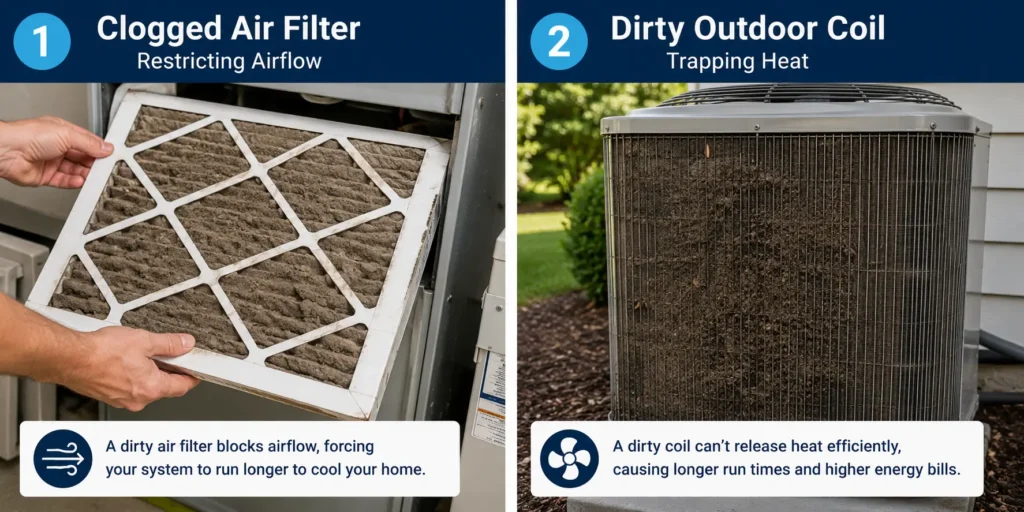
Two of the most common causes of an air conditioner running constantly are a clogged air filter and a dirty outdoor condenser coil.
Homeowners can safely:
- Remove loose leaves and debris from around the unit.
- Maintain open space around the cabinet.
- Trim vegetation that blocks airflow.
- Confirm that nothing is resting against the coil.
Do not remove electrical panels, bend the coil fins, or use a pressure washer. High-pressure water can damage the coil. Professional HVAC maintenance in Alexandria should include inspection of the outdoor coil, electrical components, system temperatures, and overall cooling performance.
- Low Refrigerant Caused by a Leak
Air conditioners do not normally consume refrigerant like fuel. If the refrigerant charge is low, the system likely has a leak, an installation problem, or an earlier charging error.
Possible signs include:
- Constant operation or longer cooling cycles
- Reduced cooling or increasing indoor temperature
- Ice on the refrigerant line or frozen evaporator coil
- Hissing or bubbling sounds
Refrigerant work is not a homeowner repair. EPA regulations require technicians who service equipment in ways that may release regulated refrigerants to hold Section 608 certification. Adding refrigerant without locating the underlying problem may provide only temporary relief. The correct process is to diagnose the system, identify the source of refrigerant loss, evaluate the repair, and charge the equipment according to manufacturer specifications.
Need AC Repair in Alexandria or Northern Virginia?
An AC that runs nonstop while losing temperature can increase operating costs and place additional stress on the compressor.
Call Integrity Now: (571) 351-7391- Dirty or Frozen Evaporator Coil
The evaporator coil absorbs heat from indoor air. Dirt on the coil acts like insulation, reducing heat transfer and forcing the air conditioner to operate longer. A frozen coil creates an even larger obstruction. Ice prevents normal airflow and can cause the system to run continuously while producing little cooling.
If ice is visible, turn the cooling system off and allow it to thaw. Do not scrape or chip the ice, as that can damage the coil or refrigerant tubing. Because thawing does not correct the underlying problem, the system should be inspected before normal operation resumes.
- Thermostat Settings or Temperature-Sensing Problems
Before assuming that the HVAC equipment has failed, verify the thermostat settings. Confirm that:
- The thermostat is set to Cool.
- The desired temperature is reasonable.
- The fan setting is Auto, not On.
- The thermostat display matches the approximate room temperature.
- The thermostat is not receiving direct sunlight or heat from nearby appliances.
When the fan is set to On, the indoor blower may continue operating even after the outdoor cooling equipment shuts down. Homeowners sometimes interpret this as the entire AC system running constantly.
- Leaky Ductwork or Undersized Return Air
An air conditioner can produce adequate cooling at the equipment while failing to deliver enough conditioned air to the rooms. Duct leakage in an attic or crawl space wastes conditioned air before it reaches the living area. Return leaks can pull hot, humid, dusty air into the system.
These problems often show up as one floor remaining warmer, weak airflow in distant rooms, excessive dust, high humidity, or long cooling cycles. Simply increasing thermostat runtime cannot overcome a major delivery-system problem.
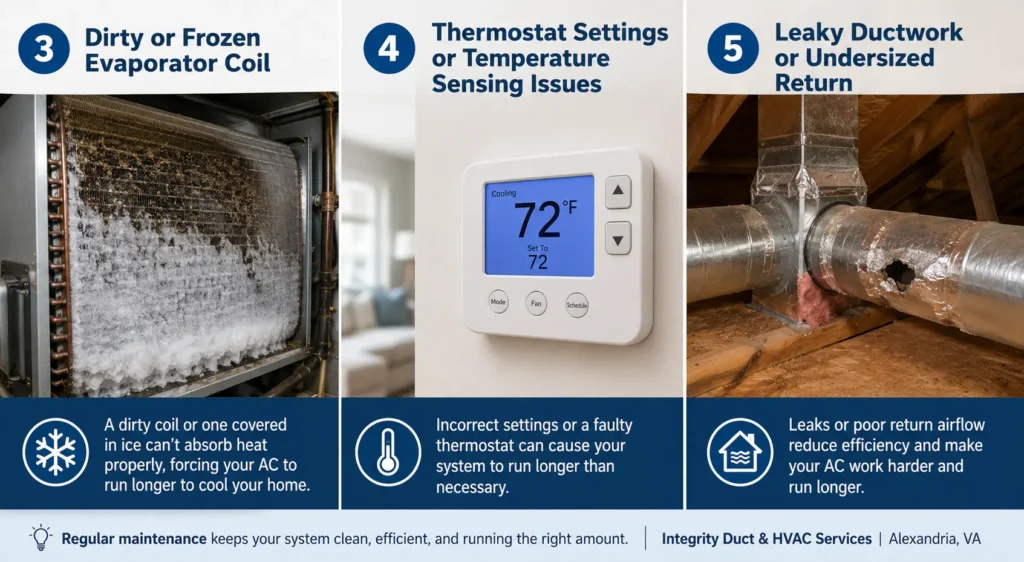
Three common reasons an air conditioner runs continuously include a dirty or frozen evaporator coil, thermostat sensing problems, and leaky or undersized ductwork.
- Insulation Problems, Air Leakage, and Excessive Heat Gain
Sometimes the air conditioner is functioning, but the building is gaining heat faster than the system can remove it. Potential sources include low attic insulation, unsealed attic access doors, aging windows, uninsulated additions, or hot attic ductwork.
This is particularly relevant when a home has been expanded or remodeled without a corresponding HVAC load calculation. The answer is not automatically a larger air conditioner; air sealing and insulation may reduce the load more effectively.
- Improperly Sized or Aging Air-Conditioning Equipment
An undersized air conditioner may run continuously because it lacks enough capacity for the home’s actual cooling load. This can happen when equipment was selected using square footage alone, a home addition increased the conditioned area, or equipment has lost capacity due to age.
Conversely, oversized equipment creates a different set of problems. It may cool the air too quickly and shut down before removing enough humidity, leaving the house feeling cold but clammy.
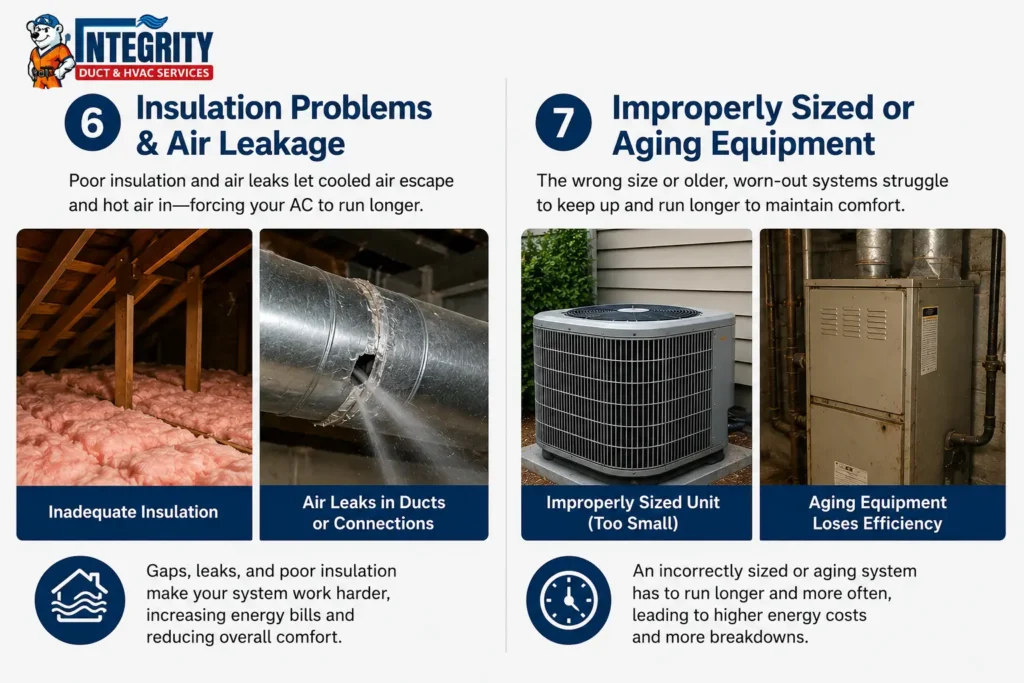
Poor insulation, air leakage, and improperly sized or aging HVAC equipment can all force an air conditioner to run longer, reduce efficiency, and increase energy costs.
AC Running Constantly but Not Cooling: What the Pattern Tells Us
An AC running constantly but not cooling usually falls into one of three broad categories:
- The System Is Not Producing Enough Cooling: (Refrigerant loss, dirty coils, compressor problems, electrical failure)
- The System Is Producing Cooling but Not Moving Enough Air: (Dirty filter, blower problem, restricted return air, blocked registers, frozen coil)
- The System Is Cooling, but the Home Is Gaining Heat Too Quickly: (Poor insulation, air leakage, excessive solar gain, attic heat, duct losses)
The Two-Hour Northern Virginia Runtime Test
Most homeowners time how long the air conditioner runs. That number alone is not particularly useful. A better test is to document whether the system is holding steady or losing ground. Choose a hot afternoon and record:
Northern Virginia Two-Hour AC Runtime Test
Record your thermostat, temperature, humidity and airflow readings over two hours. This helps determine whether your air conditioner is maintaining comfort or gradually losing ground.
| Time | Thermostat Setting | Indoor Temperature | Indoor Humidity | Outdoor Temperature | Airflow Notes |
|---|---|---|---|---|---|
| Start | |||||
| 30 Minutes | |||||
| 60 Minutes | |||||
| 120 Minutes |
What to watch: If the indoor temperature steadily rises while the AC runs continuously, the system may be losing cooling capacity. Record whether airflow feels weak, uneven or noticeably warmer upstairs.
How to Read the Results:
- The temperature remains nearly stable: The system may be operating normally under peak load, particularly if humidity is also decreasing.
- The temperature rises several degrees: The system is losing ground. This points toward reduced capacity, airflow restriction, excessive heat gain, duct loss, or sizing problems.
- The temperature falls, but humidity stays high: The equipment may be cycling improperly, moving too much airflow, or failing to remove moisture effectively.
- The first floor cools while the top floor warms: The problem may involve airflow balance, attic exposure, duct leakage, return-air limitations, or the vertical layout of the home.
Integrity Field Note: Whether the AC runs for 45 minutes or two hours matters less than what happens to temperature and humidity while it runs. Stable conditions suggest the equipment may be meeting peak demand. Rising temperature tells us the system or the building is losing the battle.
Local House-Type Clues in Alexandria and Northern Virginia
The following patterns are useful starting points—not definitive diagnoses. A local diagnosis should consider the house as a complete system rather than evaluating the outdoor unit in isolation.
| Local Housing Pattern | Common Starting Points to Inspect |
|---|---|
| Historic Old Town Row Home | Retrofitted ductwork, limited return air, upper-floor airflow, attic insulation and restricted space for modern HVAC equipment. |
| Mount Vernon or Rose Hill Rambler | Attic insulation, home additions, aging ductwork, return-air sizing and cooling-load changes caused by renovations. |
| Springfield Split-Level | Temperature imbalance between levels, return-air pathways, attic exposure and airflow distribution between living areas. |
| Kingstowne or Franconia Townhouse | Upper-floor heat gain, attic ductwork, vertical airflow, thermostat location and limited return air on upper levels. |
| Renovated Alexandria Home | Changed cooling load, enclosed spaces, relocated walls, finished additions and ductwork modified during renovation. |
| Newer Zoned Home | Zone-damper operation, thermostat controls, bypass configuration, static pressure and airflow balancing between zones. |
Local diagnostic note: These patterns help identify where an inspection should begin, but they do not replace airflow measurements, refrigerant testing, static-pressure checks or a full HVAC system evaluation.
Frequently Asked Questions
Why is my AC running all day during summer?
Long runtime may be normal during extreme heat and humidity if the system maintains the indoor temperature. It is more concerning when the temperature rises, airflow weakens, humidity remains high, or the unit never cycles off overnight.
Can a dirty filter make an air conditioner keep running?
Yes. A clogged filter restricts airflow, reduces heat transfer, increases runtime, and may eventually contribute to coil freezing.
Why is my AC running constantly but blowing warm air?
Possible causes include refrigerant loss, a frozen coil, dirty coils, compressor problems, electrical failure, or restricted airflow. Turn the system off if ice is present and arrange professional diagnosis.
Can high humidity make an AC run longer?
Yes. The system must remove moisture as well as heat. High humidity can increase runtime even when the outdoor temperature has not changed dramatically.
Will installing a larger air conditioner fix constant runtime?
Not necessarily. Oversized systems can create short cycles, uneven temperatures, and poor humidity control. Equipment should be selected using a proper load calculation and evaluation of the duct system.
Should I turn my AC off if it keeps running?
Turn it off and call for service if it is blowing warm air, freezing, leaking near electrical components, producing burning smells, tripping breakers, or continuing to operate after the thermostat is switched off.
Schedule AC Repair in Alexandria and Northern Virginia
An air conditioner running constantly is not automatically broken. During Northern Virginia’s hottest and most humid weather, it may simply be operating near its design capacity.
But when the home keeps getting warmer, humidity remains high, airflow declines, or the system shows signs of freezing or electrical trouble, waiting can turn a correctable problem into a major repair.
AC Running Constantly and Losing Ground?
If your air conditioner runs nonstop while indoor temperatures keep rising, airflow weakens, the system freezes, or electrical problems appear, the issue may need prompt professional diagnosis. Use our Alexandria emergency AC guide for homeowner checks, safety information, and details about priority cooling service.
Integrity Duct & HVAC Services provides AC diagnostics, repairs, maintenance and system replacement throughout Alexandria and Northern Virginia.
Integrity Duct & HVAC Services
Alexandria, Virginia
No. 2705191210
No. 2710081728
BBB A+ Rated | NATE-Certified Technicians | 5-Star Google Reviews | Member, Alexandria Chamber of Commerce
HVAC Services and Resources for a More Comfortable Home
An air conditioner that runs constantly may need a repair, seasonal maintenance, airflow improvements, or eventual replacement. Explore the services and homeowner resources below to find the right next step.
AC Repair in Alexandria
Get professional diagnosis for an AC that runs continuously, blows warm air, freezes up, leaks, or struggles to reach the set temperature.
Explore AC Repair → ⚙HVAC Maintenance
Seasonal maintenance helps identify dirty coils, restricted airflow, drainage problems, and worn components before they cause a breakdown.
View Maintenance Guidance → ◈HVAC Installation
Explore properly sized, energy-efficient replacement options when an older system can no longer maintain comfort reliably.
Explore HVAC Installation → ≋Duct Cleaning and Ventilation
Address dust, debris, and airflow concerns within the duct system to support cleaner circulation and more consistent home comfort.
Explore Duct Services → ⌁Indoor Air Quality
Improve filtration, humidity control, and indoor comfort with solutions selected for the conditions inside your home.
Explore Air Quality Solutions → !Emergency HVAC Repair
Get help when your system stops cooling, freezes repeatedly, leaks water, or shows signs of a serious electrical or mechanical failure.
View Emergency HVAC Service →Explore the Northern Virginia HVAC Guide
Learn more about HVAC repairs, replacement costs, system sizing, humidity, airflow, energy efficiency, and home-comfort concerns throughout Alexandria and Northern Virginia.
Related Air Conditioning Services in Alexandria VA
If your air conditioner runs constantly, won’t reach the temperature you set, or your energy bills keep climbing, our certified technicians can help. We diagnose the root cause—not just the symptoms—and recommend the most cost-effective solution for your home.
Our Related HVAC Services
- AC Repair in Alexandria VA – Diagnose refrigerant leaks, frozen coils, faulty capacitors, blower motor problems, thermostat issues, and other cooling failures.
- HVAC Maintenance in Alexandria VA – Prevent breakdowns, improve efficiency, and help your air conditioner keep up during Northern Virginia summers.
- HVAC Installation in Alexandria VA – If your current system is undersized, aging, or no longer efficient, we’ll help you choose the right replacement.
- HVAC Service Plans – Annual maintenance, priority scheduling, and discounts designed to extend the life of your HVAC system.
- Indoor Air Quality Services – Dirty filters, poor airflow, and duct issues can all affect cooling performance and indoor comfort.
Serving Alexandria & Northern Virginia
Integrity Duct & HVAC Services proudly serves homeowners throughout Alexandria, Old Town, Del Ray, Rosemont, Potomac Yard, Franconia, Kingstowne, Groveton, Mount Vernon, Lincolnia, Seminary Hill, and surrounding Northern Virginia communities.
If your air conditioner is running nonstop, blowing warm air, or struggling to keep your home comfortable, our experienced technicians are here to help.
Whether you’re searching online for air conditioning repair near me, AC repair in Alexandria VA, or a trusted local HVAC contractor, we’re committed to providing honest recommendations, quality workmanship, and dependable service.
Call (571) 351-7391 or schedule service online today.